
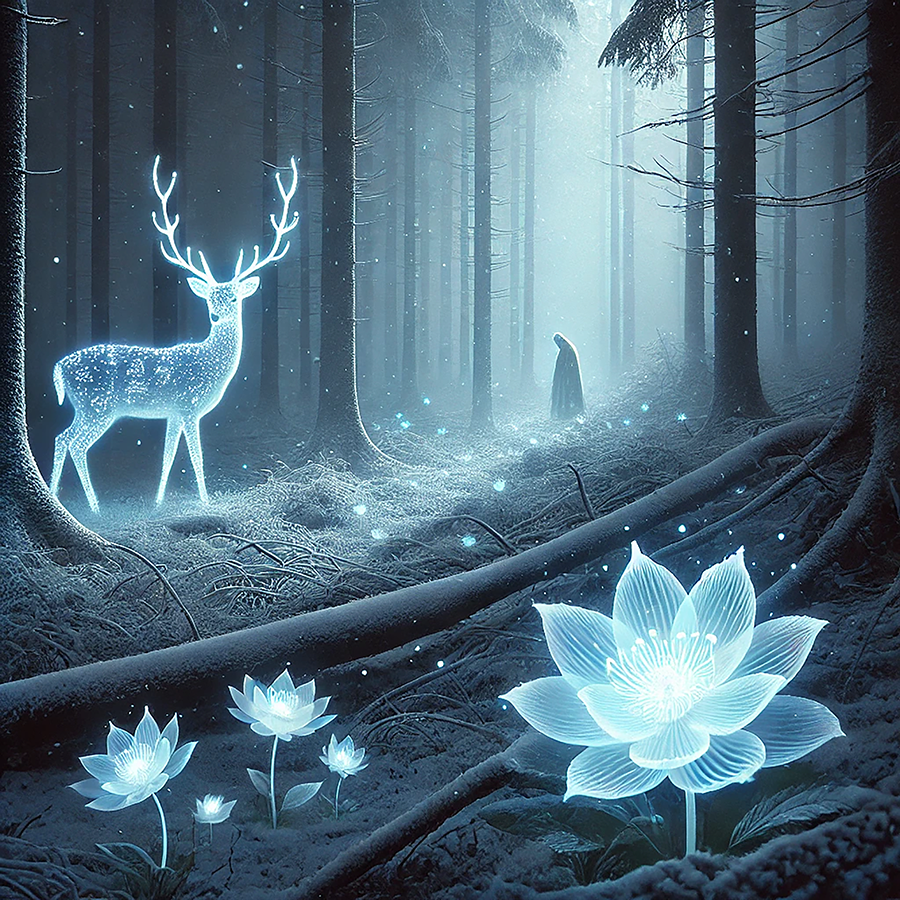
Ancient Powers

Before the first Nevran ships breached our skies, before Earthen settlements rose from wild terrain, Aerias existed in perfect harmony under the influence of powers that modern minds can scarcely comprehend. The Pre-Dawn age thrummed with energies now glimpsed only in moments of wonder or terror—forces neither fully magical nor entirely material, but existing in the liminal space where reality itself remains malleable.

The Ilyrians stood as living bridges between these realms, their presence blessing the very air they breathed. Though most departed during the Great Sundering, their influence persists in places where the boundary between worlds grows thin. The kaegar represent a darker inheritance from this ancient time—predators whose very nature defies conventional understanding, their existence a reminder that not all powers that shaped our world did so with benevolence. Between these extremes exist countless manifestations of old energy: wraithlight beings that dance between existence and memory, sites where natural laws bend to accommodate echoes of what once was, and rare bloodlines carrying traits that speak of connections to powers beyond mortal understanding.

The modern age views such phenomena through competing lenses—Guild Engineers seek to catalog and explain, traditional lore keepers preserve ancient wisdom regarding their nature, and ordinary citizens navigate life in a world where forgotten powers occasionally intrude upon comfortable certainty. What separates wisdom from superstition is not denial of these ancient influences, but clear-eyed recognition of how they continue to shape Aerias millennia after their apparent departure.

The Ilyrians

Before the arrival of mortal races, Aerias was home to beings of profound power and beauty. The Ilyrians, described in ancient Nevran texts as ‘light in human form,’ walked the world with alabaster skin that seemed to glow from within. Our language lacks words to truly capture their essence. Not gods, for they claimed no worship, yet more than mortal, for death and time touched them differently. The Ilyrians moved through the world as light moves through crystal—present yet untouchable, illuminating yet mysterious. Revered rather than worshipped, they existed in harmony with the world itself, their presence blessing the very air they breathed.

Seven in number, each Ilyrian embodied a unique aspect of creation—Guardian, Dreams, Shadows, Starborn, Song, Harmony, and the Chosen One. They communicated without words, though some accounts speak of music beyond mortal hearing that caused flowers to bloom and waters to dance.

The Great Sundering marked their departure from the physical realm, though precisely why they chose to leave remains the subject of scholarly debate. Nevran traditions maintain that certain places still bear their influence—natural sites where unexpected phenomena occur, where Shadowvein trees pulse with unusual light, or where Lumidawn flowers bloom out of season.

Though most believe the Ilyrians fully departed Aerias, whispered stories persist of rare sightings in remote regions. Such accounts are generally dismissed as wishful thinking, yet even the most skeptical scholars acknowledge that our understanding of these ancient beings remains incomplete.”

No written record exists of an Ilyrian ever speaking aloud to any mortal being. Their communication among themselves appeared to require no sound—a sharing of thought more perfect than any language could achieve. Yet they sang, creating harmonies beyond mortal hearing that made flowers bloom out of season and calmed the most violent storms. These songs, audible only to the natural world and certain animals, could be felt rather than heard—a vibration that seemed to resonate with the very essence of Aerias itself.

The earliest Nevran settlers who encountered these beings report communicating through elaborate gestures—the foundation of what scholars now call High Nevrish, preserved in the sacred archives and studied by only the most dedicated linguists. These ancient records suggest approaching an Ilyrian required not just physical purity but spiritual clarity—those harboring ill intent would find themselves unable to cross invisible boundaries that seemed to bend space itself around these luminous beings.

Starfawn Lumidawn unknown being

From the fragment of Syresh the Scholar, preserved in the Sealed Archives:

‘…She gestured for me to follow, her movements leaving trails of soft light in the air. Though I had traveled this forest path a hundred times, suddenly nothing was familiar—trees I had never seen before surrounded us, massive and ancient beyond reckoning. When I expressed confusion through signs, she merely touched her fingertip to the center of my forehead. In that moment, I understood she had not led me elsewhere, but rather, had revealed what had always been present yet hidden from mortal perception…’

Though the Great Sundering took most from our realm, certain texts suggest at least two Ilyrians chose to remain—Dramir, whose intervention proved crucial during the Third Zylvan War, and V’loriel, about whom little is recorded save a cryptic reference in the Twilight Codex: ‘The Chosen One walks still between shadow and light, waiting for stars to align once more.’ Whether this refers to an actual continued presence or merely to an enduring spiritual influence remains one of the great mysteries of our age.”
Ancient History & The Kaegars

Historical accounts of the Third Zylvan War contain troubling gaps, particularly regarding the Empire’s role during the Kaegar incursions. Official imperial histories claim their ancestors stood as bulwark against these ancient horrors, sacrificing countless lives to contain threats that might otherwise have consumed all of Aerias. Yet Nevran chronicles suggest a more complex narrative—one where certain Dromelan sects possessed knowledge of the kaegar that transcended mere military intelligence.

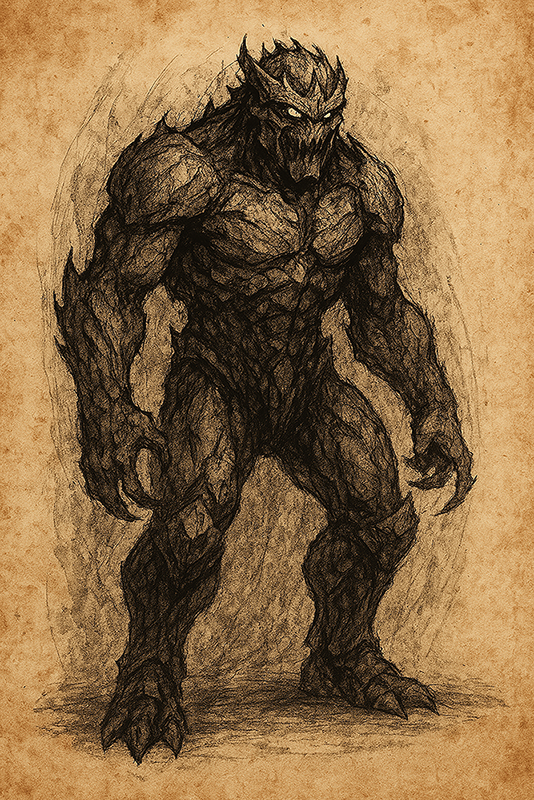
What remains undisputed is the devastating impact of these entities upon emergence. Eyewitness accounts describe creatures of nightmare—seven-foot bipedal forms with granite-like skin impervious to conventional weapons, possessing both bestial ferocity and calculating intelligence. Most disturbing were reports of their apparent enjoyment in causing terror, a quality that elevated them from mere predators to something more fundamentally malevolent.

Contemporary scholarship dismisses many details as exaggerations born of trauma and primitive understanding. The Guild of Engineers officially attributes surviving accounts to encounters with experimental bioweapons deployed during ancient conflicts, while political narratives avoid the subject entirely. Yet archaeological restrictions surrounding certain sites suggest official concern that transcends academic caution, while the persistent whispers of “sleeping armies” in Dromelan folklore hint at threats not entirely vanquished.

The Kaegar Battles (Fragments of Horror)

Few surviving accounts of the Third Zylvan War speak directly of the kaegar. Those that do bear the unmistakable tremors of absolute terror, their words preserved not as historical documentation but as warnings for generations yet unborn. The Dromelan war-poet Vhesh’kar, whose combat chronicles otherwise maintain clinical precision, abandons all formal structure when describing his first kaegar encounter:

‘Stone-flesh giants whose footsteps broke the earth beneath them—no, not stone but something that lived and breathed and hungered. When they moved through our forward line, our finest blades shattered against their hides. Their eyes carried the red of dying suns, and when they roared, brave men who had faced death a hundred times simply collapsed where they stood, their spirits broken by sounds no mortal throat should produce…

A Nevran healer’s journal, recovered from the ruins of Easthold Fortress, records desperate attempts to treat the wounded:

‘The injuries defy understanding. Where kaegar claws touched flesh, the wounds resist all traditional healing. Survivors speak of cold that burns, of feeling as though their very souls were being pulled from their bodies. Many die hours after treatment, their final moments spent in terror as they claim to see crimson eyes watching from corners where no being stands.’

Most disturbing is the fragmented testimony of Ghalarn the Witness, sole survivor of the Battle of Broken Shields, whose account was sealed by royal decree until the Seventh Age:

‘They knew us. That is what haunts me still. Not as prey knows predator, but as kin recognizes fallen kin. When their king approached our lines, he spoke—not in words, but in sensations that bloomed inside our minds like black flowers. I felt recognition in that touch, as though something in our blood remembered something in theirs…’

Modern military historians typically relegate such accounts to the realm of psychological warfare effects or mass hysteria during catastrophic defeat. The Guild’s official position maintains that the kaegar were likely an early Dromelan bioweapon whose capabilities were exaggerated through generations of retelling.

Yet one curious detail persists across all surviving accounts, regardless of their origin or recorder: the claim that conventional weapons proved nearly useless, while the mysterious ‘black metal’ warriors wielded by certain tribal forces could pierce their seemingly impervious hides. The composition of this material remains unknown, all samples having been reportedly gathered and sealed away after the conflict’s resolution.”

Of all recovered materials, one sketch has never been publicly displayed—until now.

Recovered Sketch: “Vzk’rth” – Identity Unconfirmed
Preserved under lock within the sealed vaults of the Grand Archives, this charcoal depiction is believed to originate from the Third Zylvan War, likely rendered by a Nevran scout moments before their final dispatch. Guild restoration confirmed no known pigment or medium matches the markings on the parchment. The image burns faintly when left in darkness and induces physiological discomfort in sensitive viewers.
“If this is what stalked the northern front, we are fortunate history buried it.”
—Archivist Veilan, 5th Compilation Cycle

The Furi (Ancient Legends)

Among the most disputed entries in the Dromelan Forbidden Archives are fragmentary references to beings called ‘furi’—a term roughly translated as ‘fire walkers’ or ‘those marked by inner flame.’ According to these controversial texts, these rare individuals emerged from bloodlines where human and kaegar essence had somehow merged, though modern scholars dismiss such accounts as symbolic rather than literal.

The texts describe furi as appearing outwardly human, with only subtle markers of their dual nature—perhaps unusual resilience or inexplicable reactions when injured. Most telling was their blood itself, which reportedly crystallized when exposed to air, turning black as obsidian and carrying toxic properties against kaegar flesh alone.

From the sealed testimonies of Lorekeeper Vharu:

‘The accounts suggest nature itself would recognize a furi’s presence—trees responding to their passing, certain animals growing either unusually calm or inexplicably agitated. More troubling are claims that kaegar could sense these individuals across vast distances, drawn to them with a hunger beyond mere predatory instinct—a recognition of their own essence twisted into something they both despised and desired.’

The concept survives primarily in children’s tales of the Eastern Territories, where parents still whisper of the ‘night child with starlit blood’ who protected villages when ancient evils stirred. Guild historians classify such stories alongside other improbable myths, noting the biological impossibility of viable offspring between entirely different species.

Most lore keepers consider the furi a symbolic representation of how Dromelan society viewed those who straddled cultural boundaries during ancient conflicts—neither fully belonging to one world nor the other. A few fringe scholars maintain the legends might have originated with individuals who possessed rare blood disorders or unusual resistance to certain toxins.

Whatever truth might lie beneath these fragmented accounts, all known references cease abruptly following the Third Zylvan War, suggesting the concept held significance only within that specific historical context.”

The Lore Keepers (Brief Mention)

Throughout Aerias’s long history, certain individuals have dedicated themselves to preserving knowledge of ancient powers and historical truths that might otherwise be forgotten or deliberately obscured. These Lore Keepers transcend racial and political boundaries, found among Nevrans, Dromelans, and Earthens alike.

Unlike formal historical institutions or Guild archivists, Lore Keepers operate through informal networks, passing knowledge through generations via oral traditions, encoded texts, and sacred objects. Their exact purposes and methods remain largely mysterious to outsiders, though their influence occasionally surfaces during times of crisis.

The most respected Lore Keepers possess knowledge that contradicts official histories, particularly regarding ancient conflicts and powers that shaped the modern world. While some dismiss them as mere custodians of legend, others recognize them as guardians of truths too dangerous for common knowledge.

The Great Sundering

Cataclysmic period between 3200-3800 N.C. when the Pre-Dawn beings, including most Ilyrians, departed from the mortal realm of Aerias. Nevran texts describe this exodus not as a single event but as a gradual withdrawal as these ancient powers grew increasingly disillusioned with the mortal races’ conflicts and ambitions. The Sundering manifested through dramatic natural phenomena—auroras that lasted for weeks, unexplained astronomical alignments, and regions where reality itself seemed to thin. In its final phase, witnesses reported seeing the Ilyrians walking into impossibly bright light or simply fading from view while speaking words in languages no living being could comprehend. The departure of these primordial forces fundamentally altered Aerias’s metaphysical landscape—certain types of natural magic waned, while others grew stronger in their absence. Most historical accounts agree that only two Ilyrians, Dramir and V’loriel, remained after the Sundering’s completion, though their ultimate fates remain subjects of scholarly debate. Annual ceremonies in Nevran communities still commemorate this watershed moment when, as their poets say, “the world grew smaller as the stars grew more distant.”

Ancient Artifacts:

The Aether Stone

Ancient crystalline artifact that serves as the Central Kingdom’s symbol of royal authority. Distinguished by its opalescent surface that seems to capture and transform light, the stone’s true origins remain disputed among scholars. Guild Engineers classify it as a “resonant crystal” of unprecedented purity, while Nevran lore suggests it is a fragment of starlight solidified during the Pre-Dawn age. When worn by the rightful monarch, the stone responds with a subtle inner luminescence that cannot be artificially replicated, making it both symbol and proof of legitimate rule. Beyond its ceremonial function, the stone is said to possess certain protective qualities, though detailed accounts of these properties are restricted to royal archives. The current stone was set into its distinctive gold setting during the reign of King Ronan, who commissioned master craftsmen to create a mounting worthy of its significance. Counterfeit versions occasionally appear in black markets, but none have successfully mimicked the stone’s unique optical properties or its mysterious resonance with bloodline succession.

Legendary Creatures:

The Alq'arus

Majestic golden birds believed extinct since the Pre-Dawn age, distinguished by their unique split wings that could rejoin when paired with another of their kind. Historical accounts describe them as massive creatures with wingspans reaching twenty feet, their feathers glowing with inner light like captured sunrise. The most remarkable feature of the Alq’arus was its binary nature—each bird possessed wings that could separate and rejoin, symbolizing division and reunion. This characteristic made them powerful symbols in Nevran mythology, representing bonds that transcend physical separation. Ceremonial pendants shaped like these creatures are sometimes divided between loved ones as tokens of unbreakable connection, with the understanding that the halves will eventually reunite.

Golden Alq'arus Pendant Smaller
The Alq’arus Pendant — a relic from the First Age, its twin halves passed between Markus and Xara. In Nevran tradition, the united wings signify renewal and unbroken bonds.
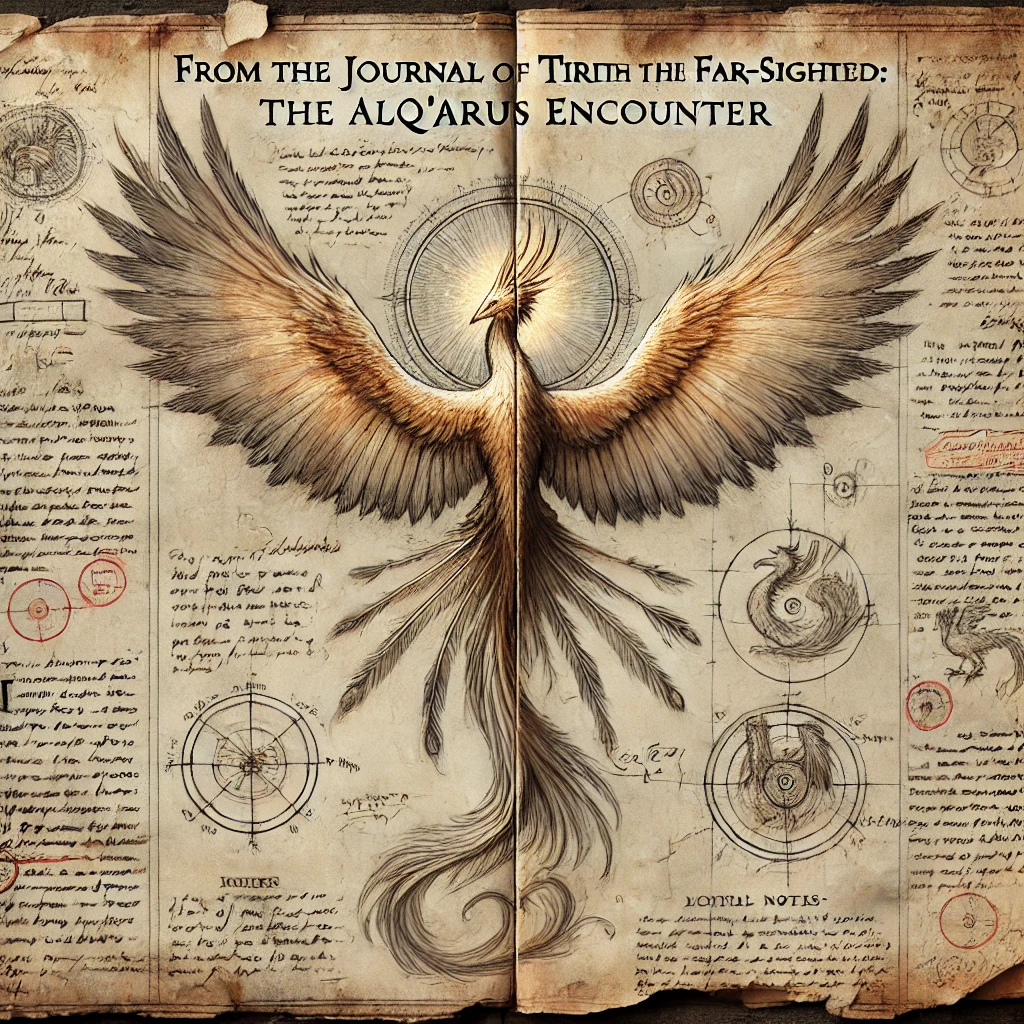
Alq’arus

The Alq’arus (An Ancient Encounter)


In the earliest archives of the Q’iirev house, preserved in crystal memory-stones, there exists an account from Tirith the Far-Sighted, who claimed to have encountered a nesting pair of Alq’arus in the Third Year of Settlement:

‘They moved like living gold through morning mist, their wings creating patterns that seemed to ripple through the very air itself. When the larger one turned its gaze upon me, I felt as though my very soul had been weighed and measured—not with judgment, but with a curiosity that seemed to belong to the stars themselves. Its call rang like bells cast from sunlight, and for seven days afterward, I dreamed of skies beyond our knowing.’

Most scholars dismiss Tirith’s account as poetic embellishment, noting how conveniently no others witnessed this encounter. Yet when the last confirmed Alq’arus sighting was recorded—by seven independent observers during the Winter of Long Shadows in 2133 N.C.—they described an identical resonant call that ‘lingered in the mind long after its echo faded from the air.’

More curious still are the twin golden feathers preserved in the Sealed Archives of Niri, whose microscopic structure defies both natural explanation and Guild replication efforts. Guild

Archivist Ellenmir famously noted after her examination: ‘If these are forgeries, then whoever crafted them understood principles of light manipulation that our most advanced resonance-crystals are only beginning to approach.’

The ancient Nevran proverb still whispered between parted lovers—‘When Alq’arus reunite, so shall we’—suggests these magnificent creatures may have carried meaning beyond mere biological wonder. Whether they truly possessed the ability to separate and rejoin their distinctive split wings, as folklore suggests, remains a mystery that died with their kind.”

Wraithlight Beings

Ethereal entities that inhabit the infamous Wraithwoods, appearing as beautiful, luminous humanoids when observed from a distance but revealing terrifying forms when approached directly. Neither fully spectral nor material, these beings exist in a state between realms, seemingly able to manipulate perception and emotion in those who encounter them. Nevran scholars believe they represent echoes of Pre-Dawn beings trapped during the Great Sundering, while local folklore identifies them as souls of those who suffered violent deaths during ancient conflicts. Their most dangerous ability appears to be emotional manipulation—drawing travelers deeper into the woods with sensations of wonder and curiosity before manifesting terror and confusion. Guild technology functions erratically in their presence, suggesting fundamental incompatibility between their nature and modern scientific principles.

Scroll to Top