
Flora and Fauna

Aerias teems with life forms that defy simple categorization—creatures and plants whose very existence blurs the boundary between natural evolution and ancient influence. Since the Pre-Dawn era, when Ilyrians walked among the first blooming Lumidawns, the world’s living tapestry has woven itself into patterns both beautiful and dangerous. The most remarkable species seem to remember a time before mortal civilization, responding to energies that pulse beneath the kingdom’s foundations.

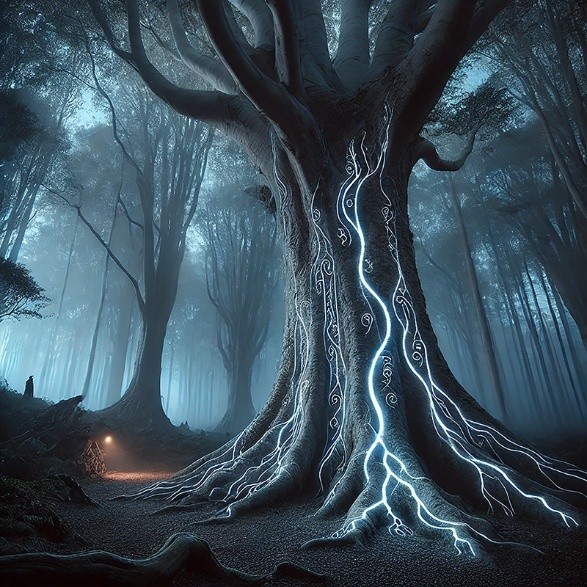
The forest holds tales written in living script—Shadowvein trees whose pale striations pulse with blue light in response to ancient powers, Songbarks whose resonant tones communicate in ways scholars still struggle to comprehend, and predators whose very presence causes the natural world to fall silent. In these organisms, Aerias preserves memories no historical record could capture, their behaviors and characteristics serving as living echoes of what came before. Though Guild Engineers have documented countless species through clinical observation, true understanding comes only to those who recognize that flora and fauna exist not merely as biological specimens, but as keepers of wisdom that predates written language itself.

Remarkable Flora:

Shadowvein Trees

Shadowvein Trees

Distinguished by their pale bark marked with striations that pulse with subtle blue-white light, Shadowveins grow predominantly in ancient forests like Moorwood. These massive trees respond to the presence of powerful entities—their luminescence intensifying near ancient beings or individuals with awakened abilities. Nevran lore suggests the trees’ distinctive patterns record events that occurred beneath their branches, with the oldest specimens preserving memories from before human settlement. Their wood resists rot and fire, making it prized for ceremonial structures, though cutting a living Shadowvein is considered taboo in most cultures.
Mistweep Trees

Recognizable by their drooping branches that constantly release a fine, mist-like moisture, Mistweeps create microenvironments of perpetual dampness. The mist carries trace minerals that nourish specialized understory plants, creating unique ecological niches around each tree. During dawn and dusk, the moisture refracts light in distinctive patterns that Nevran seers use for divination. Guild Engineers have recently discovered the mist’s unusual conductive properties, leading to experiments in alternative power transmission that remain in early development stages.

Songbark Trees

These ancient hardwoods produce resonant tones when wind passes through their specialized bark formations. Each tree develops a unique “voice” over centuries of growth, with older specimens capable of complex harmonies that Nevran musical traditions seek to emulate. During significant metaphysical events, Songbarks sometimes produce tones without wind—a phenomenon that coincides with movements of ancient powers. Their heartwood contains natural crystalline structures similar to those used in Guild communication technology, leading some scholars to suggest these trees may form their own communication network independent of human understanding.

Emberwood Trees

Distinguished by their deep red foliage and unusual heat retention properties, Emberwoods grow primarily in northern regions where their thermal characteristics create warm microclimates during harsh winters. Their bark contains naturally occurring compounds that burst into brilliant flame when ignited, while remaining remarkably resistant to unintended burning. This paradoxical nature makes them simultaneously prized for controlled fire applications and avoided as construction material. Nevran traditions hold that Emberwoods mark locations where Ilyrians once blessed the land, their heat a lingering echo of ancient presence.

Other notable trees:

Bloodrot – trees with deep red heartwood

Skytower – extremely tall trees with silvery bark

Thornspire – defensive trees with spiral patterns of thorns

Spiral Spine – evolved from pines/seedlings brought here by the Earthens but with a twisted growth pattern

Ghost Oak – adapted to Aerias’s different light conditions

Shimmer Maple – developed iridescent leaves due to mineral absorption


Fauna Ecosystem:

Moonvine – climbing plants that grown faintly at night

Frostfern – gives off a cool mist when touched

Sweetbriar – thorny brushes with healing properties

Dreambloom – flowers that release sleep-inducing pollen

Memorymoss – moss that retains impressions of what touches it

Lumidawn

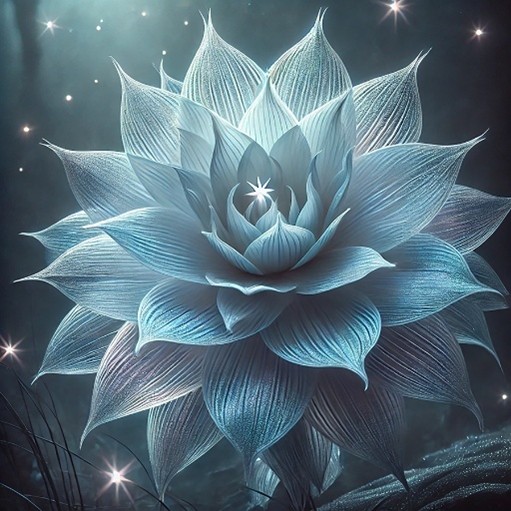
Lumidawn – A rare and delicate flower with translucent petals that seem to capture and amplify light. The petals spiral outward in a double helix pattern, each one slightly iridescent with an inner luminescence that pulses gently, like a star breathing.

They normally bloom only during the spring equinox and summer solstice, when Aerias’s magnetic fields are strongest. The flowers absorb this energy during their brief blooming period, storing it within their stems.

It has an opalescent quality that shifts between pale blue and silver in normal light, but in darkness, it emits a soft, ethereal glow that resembles starlight caught in morning dew. The center of the flower holds the strongest luminescence, creating a corona effect.

According to Nevran legend, these flowers first bloomed where the ancient and immortal Ilyrian’s tears. They’re said to be fragments of celestial light given earthly form. According to writer and historian Tovrek (circa 2568 N.C.), “The old stories say you can track an Ilyrians’ path by the impossible bloom they leave behind – Lumidawns in winter, roses in autumn, life persisting where it shouldn’t. It’s as if nature itself bends its rules in their presence, reaching toward their light like flowers towards the sun.”
Domesticated Animals:

Hushners

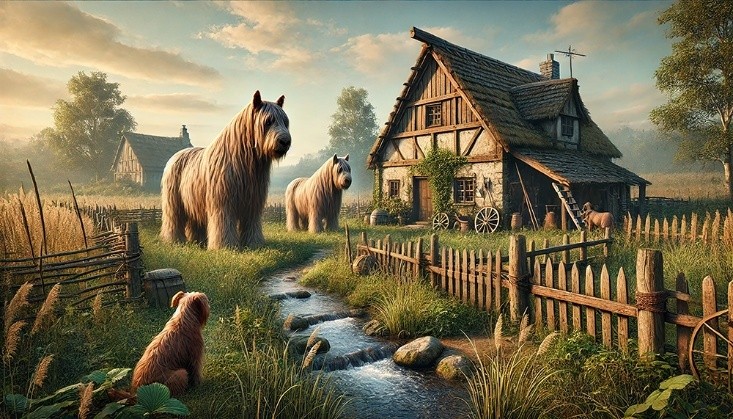
The primary domesticated beasts of burden throughout Aerias, Hushners combine tremendous strength with gentle temperament and unusual intelligence. Standing six feet at the shoulder with massive, broad frames, they can carry loads that would require multiple horses in other realms. Their distinctive feature is an almost supernatural quietness—despite their size, a Hushner’s footfalls make virtually no sound, and their vocalizations remain barely audible even when expressing distress. This quality made them invaluable for ancient military operations and continues to serve merchants who travel dangerous routes. Nevran tradition holds that Hushners were blessed by Mirazien, the Ilyrian of Dreams, granting them the ability to move between sleeping and waking worlds.

Native to the plains and farmlands of the Nevran Kingdom, Hushners are gentle, intelligent beasts often raised in tandem with livestock and family hounds.
Terradogs

Massive grazing mammals that roam the northern plains in small family groups, Terradogs stand over seven feet tall at the shoulder when fully grown. Despite their imposing size, they display remarkable gentleness with those who approach them respectfully. Their intelligence exceeds most non-predatory species, with documented instances of problem-solving behavior and complex social structures. Nevran traditions describe ancient bonds between their people and these creatures, though modern relationships remain limited to occasional mutual tolerance rather than true domestication. Their distinctive padded feet distribute their enormous weight, allowing them to move with surprising stealth despite their size.

Domesticated Herd Animals:

Woolbacks – Sheep-like creatures with unusually thick, iridescent wool that changes color slightly with the seasons. Their docile nature and valuable wool make them common in rural areas.

Hornstriders – Cattle-like beasts with four stubby horns and tough hides. They’re prized for both meat and milk that carries subtle flavors of whatever Shadowvein trees grow nearby.

Ridgebacks – Pack animals similar to oxen but with a distinctive bony ridge along their spine that farmers often decorate with colored cloth to denote ownership.

Poultry and Small Stock:

Crownfeathers – Chicken-like birds with elaborate plumage that fans out when alarmed. Their eggs have naturally blue-tinted shells.

Chatterlings – Small, rabbit-sized creatures that make soft clicking sounds when content. Raised for their silky fur and tender meat, they’re often kept in burrows beneath farmhouses.

Specklegrazers – Goat-like animals with spotted coats that shift patterns with the seasons. Known for eating almost anything, including Whisperleaf, which gives their milk a distinctive herbal quality.

Work Animals:

 Fieldrunners – Dog-sized creatures with six legs that farmers use to herd other animals. Their natural instinct to run in patterns makes them excellent for managing even temperamental livestock.

Burrowdiggers – Badger-like animals trained to locate water sources and till soil. Their sensitive whiskers can detect moisture deep underground, making them invaluable in drier regions.

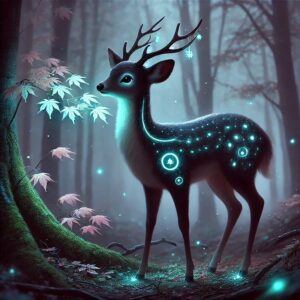
A juvenile Star Fawn—rarely seen outside deep woodland sanctuaries. Said to be celestial-touched, its glowing glyphs pulse in rhythm with the seasons and the stars.
Forest Creatures:

Starfawns

Deer-like creatures with bioluminescent patches that pulse softly

Their presence is considered a good omen

They appear most often near Shimmer Maples, feeding on the iridescent leaves

Their antlers have properties valued by Nevran healers

Mistsingers

Bird-like creatures that generate their own mist

Their calls create patterns in the air that linger like smoke

Often found near Mistweep trees

Their songs are said to carry messages from the ancient world

Rootweavers

Badger-sized creatures that tunnel between the roots of Songbark trees

Their movement causes the trees to resonate with different tones

They have a symbiotic relationship with the forest’s ancient trees

Represent the connection between the physical and mystical aspects of Aerias

Nightcallers

Owl-like creatures that can mimic any sound they hear

Their wings are completely silent in flight

Often found near Whisperleaf trees

They serve as a natural security system for those who know how to interpret their vicinity

Wild Creatures:

Saber Wolves

Saber Wolves

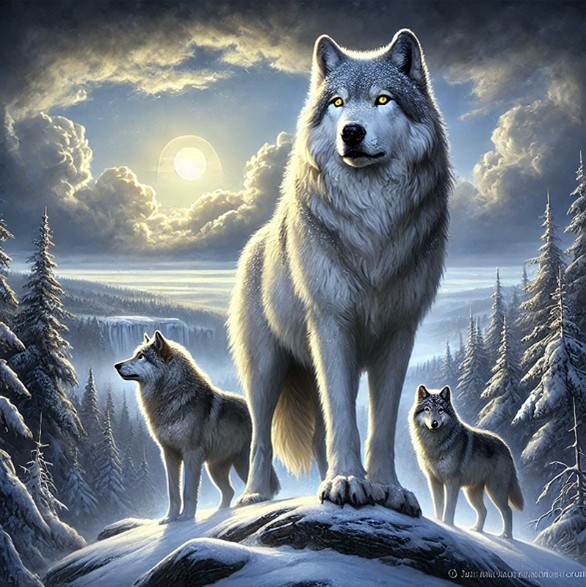
Apex predators of Oravon’s northern regions, distinguished by their massive size and uniquely retractable canine teeth that extend up to three inches when threatened or hunting. These formidable fangs remain concealed until the wolf growls in aggression or attacks, at which point they extend with devastating speed, often continuing to elongate as they tear into prey, causing catastrophic internal damage. Unlike their smaller woodland cousins, saber wolves operate in complex social hierarchies led by mated alpha pairs, with silver females (called “luna wolves” in local folklore) often serving as the pack’s true decision-makers. Their intelligence is well-documented—they’ve been observed setting ambushes, using diversionary tactics, and even manipulating simple mechanisms. Their most feared hunting technique involves driving prey toward natural barriers where their extendable fangs can deliver devastating strikes. While primarily nocturnal, they’ve been known to hunt during daylight hours when desperate or protecting territory. Despite centuries of bounties placed on their pelts, saber wolves have proven remarkably resilient, adapting to human encroachment by becoming more elusive rather than less aggressive. Rural communities mark their territories with distinctive warning stones as a mutual boundary agreement that even these fearsome predators seem to respect.
Scroll to Top