
Geography and Climate
Planetary Overview
Aerias shares many characteristics with the ancestral homeworlds described in oldest records—a hospitable planet within its star’s habitable zone, with vast oceans and diverse landmasses. However, its distinctive atmospheric density at higher altitudes has prevented any successful orbital escape since the original landings millennia ago, effectively isolating its inhabitants from their origins. The planet features two moons: Idriel, which casts a greenish glow, and Marea, with its distinctive purple light, creating unique tidal patterns and celestial phenomena that have shaped many cultural traditions.
Climate Patterns
Unlike some ancestral worlds, Aerias features a relatively mild equatorial band, with increasingly severe conditions toward the poles. The Central Kingdom occupies the temperate northern hemisphere, where seasonal changes follow predictable patterns that support agriculture and settled civilization. The North Sea’s treacherous weather systems effectively isolated the Heavenly Isles until Second Age navigation techniques finally allowed regular passage.
Key Geographic Features
The continent is defined by several major features that have shaped settlement patterns and cultural development:
- The Donashkan mountain range, forming a natural defensive barrier along the kingdom’s southern border
- The Velucian River system, providing vital transportation and agricultural support to interior regions
- The Bronze Hills, whose mineral wealth fueled the rise of Guild technology
- The ancient forests (Moorwood, Wraithwoods) where the boundary between physical and mystical realms remains thin
The Walls of Dressen
A treacherous coastal cliff formation rising three hundred feet above the North Sea, named for Admiral Dressen who first mapped the surrounding waters. The Walls’ distinctive feature is their seemingly sentient nature—the stone appears to shift subtly when climbed, as if the very rock resists human presence. Nevran seers claim the formation contains trapped spirits from the Pre-Dawn age, while Guild Engineers attribute the phenomenon to rare crystalline deposits reacting to physical pressure. What’s undisputed is the Walls’ deadly reputation—they’ve claimed more lives than any other training ground in the Immortals’ trials, earning them the grim nickname “The Widow Maker” among local sailors. The surfaces appear to memorize climbing patterns, making each ascent uniquely dangerous as the rock adapts to counter familiar strategies.
The Wraithwoods
An ancient forest in northern Oravon where the boundary between worlds grows perilously thin. Distinguished by pale, luminescent bark and perpetual mist, the Wraithwoods are home to entities neither fully spectral nor material. These “wraithlight” beings appear as beautiful, ethereal humanoids when observed from a distance, but reveal terrifying forms when approached directly. Local lore claims they are souls of those who died violent deaths during the Third Zylvan War, while Nevran scholars believe they’re echoes of Pre-Dawn beings trapped between realms during the Great Sundering. The forest’s most dangerous feature is its ability to disorient travelers—paths shift, landmarks vanish, and time itself seems to flow differently beneath its canopy. Guild technology functions erratically within its boundaries, and even the bravest hunters skirt its edges rather than venturing into its depths.
Key Locations
Oravon stands as the southernmost of the ‘Heavenly Isles,’ that trio of lands across the treacherous North Sea marking Aerias’s furthest northern reach. Ancient sailors avoided the fiftieth parallel entirely, believing these mist-shrouded lands were protected by Celestar decree, with violent tempests conjured by Ilyrians serving as natural deterrents against mortal encroachment.
According to cartographer Sylvahr (circa 3214 N.C.), these territories remained unexplored until the Second Age, when Zylvan Empire expansionists, driven by competition with newly-arrived Earthens, finally breached the storms to establish the first colonies.
Modern Oravon serves as what Guild officials term a ‘Transition Zone’ – a kaleidoscope of cultures where technologies and traditions from across Aerias converge. Its harbors showcase this convergence vividly: sleek hydro cruisers dock alongside traditional sailing vessels retrofitted with salvaged hover technology, while merchants from a dozen species conduct trade in languages that blend ancient terms with modern commerce. Here, where different technological and cultural levels intersect; opportunity mingles dangerously with lawlessness. The local saying claims that ‘in Oravon, anything can be bought or sold – including the law itself.
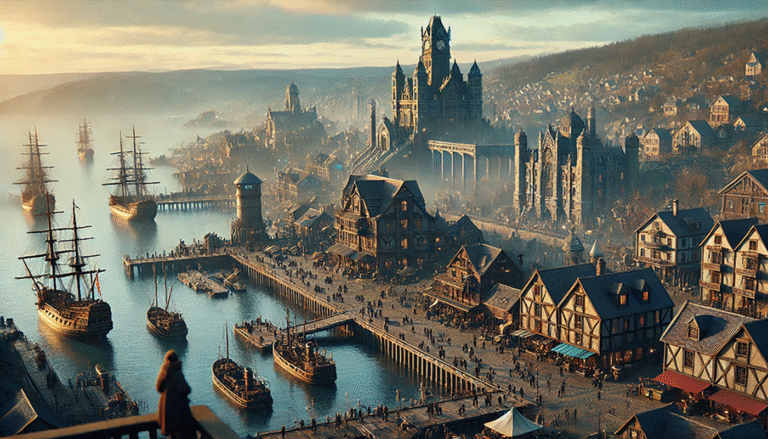
The Free Port of Cenovira — Southern Oravon’s vital gateway to the North Sea. Though not bound to any one nation, the port maintains strong allegiances with both the Central Kingdom and the Nevrish High Kingdoms. Guild presence is visible but unofficial, and beneath the harmonious bustle lies a quiet understanding: anything can be bought, traded, or silenced — for a price.
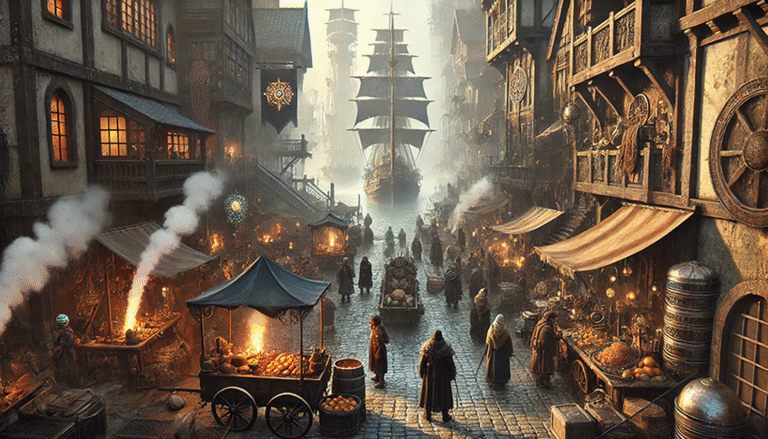
Docks of Cenovira — The smell of spice, brine, and steel fills the air as vendors shout prices and forge-side steam hisses through the alleys. Nobles and fugitives walk the same cobbled paths here, though few make eye contact. In Cenovira, everyone is from somewhere else — and everyone has something to hide.
Orwein nestles in a fertile valley where Nevran traditions remain as deeply rooted as the crops that sustain it. The community’s rhythm follows three distinct harvests that have marked local life for centuries, their cycles celebrated in festivals that blend spiritual reverence with practical thanksgiving. While Guild ‘synthfarmers’ and ‘techcultivars’ have established a minor presence with their modern machinery, these ‘Metalheads’ (as locals mockingly call them) find their innovations consistently outperformed by age-old methods perfected through generations. The landscape itself seems to resist modernization – Shadowvein trees grow more vibrantly near traditional farms, while Mistweeps provide natural irrigation that Guild systems struggle to replicate. Here, the past doesn’t merely coexist with the present; it quietly demonstrates its superior wisdom.
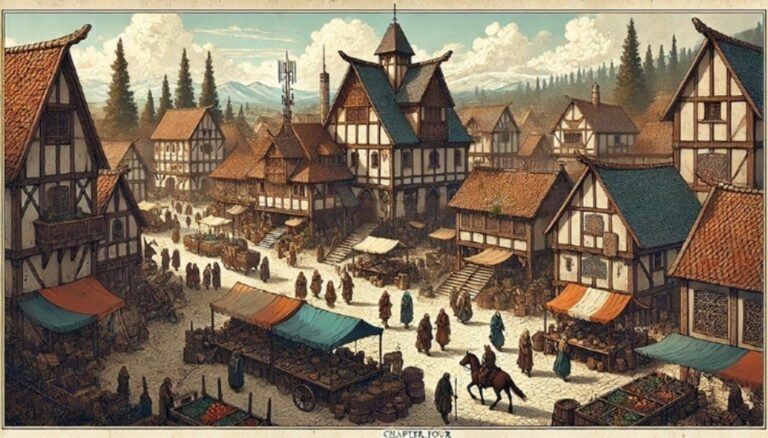
In Orwein, the streets never sleep and the stories never end. Beneath market awnings and tower spires, fate often wears a humble cloak.
Vesper stands as the southernmost district of the kingdom, a sprawling metropolitan hub where ancient stone meets modern metal, and Guild technology clashes with traditional methods. Positioned at the crossroads between rural farming communities to the northwest and military fortifications guarding the Donashkan River and peaks, its strategic location belies its political oversight. Despite its industrial significance, Vesper lacks senatorial representation, falling instead under the gubernatorial legislature of Cyrinth, a hundred miles east. The district thrives as a center of industry and trade, processing raw goods, metals, and valuable elements mined from the coastal Bronze Hills. Its streets tell the story of a city divided – neon signs blazing for the highborn while shadows claim the alleys below, where survival often means walking the line between law and necessity.

The skyline of Vesper—where the rusting alleys of the Lower Wards melt into the neon towers of the Ascendant Quarter. Beneath the glow, loyalties shift and shadows walk on two legs.