
The Languages of Aerias
“While the Common Tongue serves as the bridge between peoples, older languages persist like underground rivers, surfacing in moments of power and significance. The Nevran tongue, with its liquid grace, remains strongest in the eastern kingdoms, where ancient phrases still hold power in ritual and ceremony. High Nevrish, preserved by scholars and priests, carries echoes of the Pre-Dawn age, its words capable of touching deeper truths than modern speech can reach.
More ominous are the forbidden tongues, such as the dark speech used by certain Dromelan sects. These ancient languages carry power in their very utterance, their words seeming to distort the air itself. Such speeches are rarely heard in the modern age, and when they are, wise folk turn away.”
Nevrish
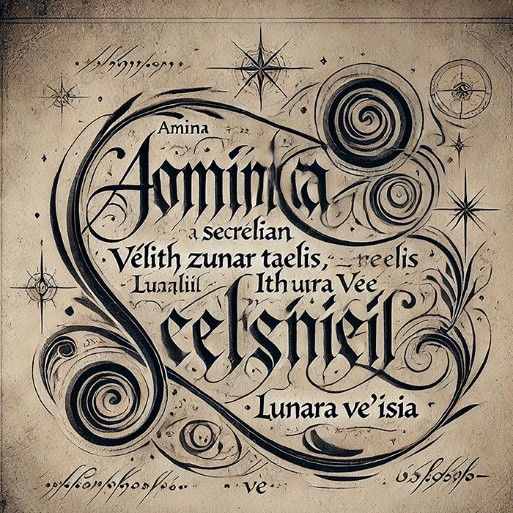
The Nevran tongue flows like water over smooth stones – a language of fluid grace that remains strongest in the eastern kingdoms. Its words carry the rhythm of ritual and community, each syllable rich with vowels that seem to connect speaker to listener in bonds deeper than mere communication. When spoken in greeting or blessing, Nevrish creates harmonies that echo ancient ceremonies while serving modern needs. Phrases like “Anusiéri” (Good morning) and “Si Ramer éliune” (Bestowing a blessing) reveal a people who see language not merely as function but as art, a daily expression of their cultural essence. In the quiet evenings of Orwein and beyond, it serves as both practical tool and spiritual conduit, binding communities together through sounds as old as their oldest traditions.
Anusiéri – Good morning
Aviero—Good evening
Si Ramer éliune — Bestowing a blessing, similar to the Earthens using ‘God bless you’.
Vehl Rishnia – Greetings, Friend
Zivo Nali – Do you need help?
Zu tol, Eingiliaz – Do you speak English? (Or preferably – The Common Tongue)
X’araiel – Brightest Jewel
Tarnüra – A formal greeting of respect
Khanz Ball/ “Vélura’khanz” – “vélura”(meaning “unity” or “partnership”) with “khanz” (referencing the high plains region in Myzara and the game’s tribal origins)
Amaviir – “Harmony of riders”
“Sé’ramir”—“Storm riders” or “Those who dance with thunder”
Finnor – ‘Friend’
Ka’ene/ Ka’aine – (Nevrish Etymology) ‘ka’ (fire/burning) + ‘en/ene’ (within/blood); Describes a condition or state of being; Modern translations – “One marked by inner fire” or “bearer of burning blood”
Amina sérielian, Vélith zunar taelis, Ithramiel, Ithramiel, Lunara ve’isia – “By ancient starlight, I claim you as mine / Protected, protected / Under my light”
Zyria eth’véliu — “Forever my child”
Amin tya valos tuul amari —”I seek the path of truth.”
T’ael zavi nu Lindiur, elna niyet?— “Are you of the Lindiur, or another?”
Izil zunae, ral miril nu wren— “May the stars guide you through the dark.”
Dromelish
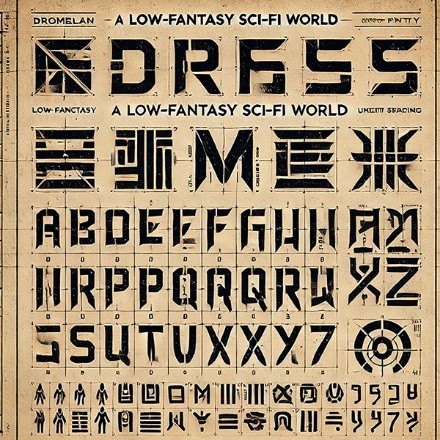
Where Nevrish flows, Dromelish commands. The Dromelan language strikes the ear with deliberate force – a tongue forged in martial tradition and honed through millennia of hierarchical society. Its harsh consonants and sharply defined syllables carry the weight of authority in phrases like “Kragath vormir” (Stand your ground) and “Skoroth na’vel” (Blood remembers). When spoken in formal settings, it creates an immediate sense of order and rank, each word precisely placed like a stone in ancient monuments. Dromelish demands respect rather than requests it, mirroring a culture where tradition and strength remain paramount values. In council chambers and battlefield commands alike, its patterns reveal a people who revere structure, honor ancestral oaths, and believe that words, properly spoken, carry power beyond their mere sound.
“Kragath vormir” – “Stand your ground”
“Vex’thal menuk”– “By ancient right”
“Skoroth na’vel” – “Blood remembers”
“Drakmir tuvalsk” – “May shadows guide you”
“Tharak’vor” – Sacred oath/blood bond
“Mekrath” – Elder council
“Vosk’nar” – Ritual combat to settle disputes
“Khravek” – Soul essence/life force
“Skarazh” – The ancient texts/forbidden knowledge
“Drakh’tovar” – Ancestral blade
“Nathiir” – One who walks between worlds (mystic/seer)
Dromelan Linguistic Evolution
Modern scholars note that certain ancient Dromelan terms have been simplified over millennia of cross-cultural contact. The most notable examples involve terms related to their oldest legends:
Kaegar – Originally pronounced “Kraeth’gar” or “K’zhaegar” in ancient Dromelan texts, this term gradually simplified in common usage as the actual beings faded into legend. The compound meaning remains intact: “kae” (shadow) + “gar” (hunter).
Furi – The ancient Dromelan pronunciation “Vskh’furi” or “Fhur’ith” has been rendered in modern texts simply as “furi”. The root components “fur” (fire) + “i” (walker/one who embodies) create the compound meaning “fire that walks” or “walking flame.”
This linguistic evolution mirrors how many complex terms become streamlined through cultural exchange and practical usage, particularly for concepts that transition from common knowledge to historical reference.
High Nevrish
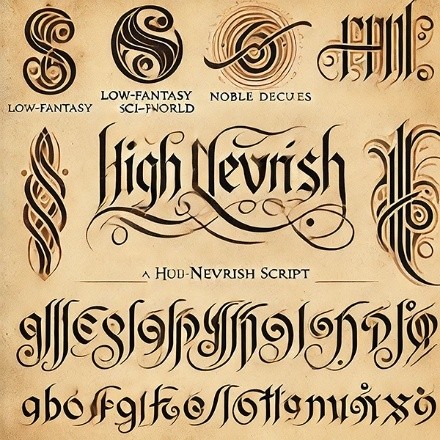
High Nevrish persists like an underground river, surfacing in moments of power and significance. Preserved by scholars and priests, it carries echoes of the Pre-Dawn age, its words capable of touching deeper truths than modern speech can reach. Created not as common language but as sacred vessel, High Nevrish originated from early communication between mortals and Ilyrians, combining written forms with intricate hand gestures that scholars still study today. Terms like “Ma’eth serai” (Farewell) and “Muri-elèzon” (A term of endearment) preserve concepts inexpressible in everyday tongues. Though no longer spoken in daily life, it remains alive in ancient texts and ceremonial occasions, where its carefully preserved phrases open doorways to understanding that would otherwise remain closed. When properly intoned, it creates spaces where the boundary between past and present grows thin, allowing glimpses of wisdom otherwise lost to time
Sélaris anu – “Light be with you” (a common blessing)
Vélim ara – “Welcome, pure one” (greeting for someone deemed worthy)
Elyon sirae – “May your heart sing” (a farewell or wish)
Lunara véis – “Moonlit breath” (referring to nature’s response to Ilyrian song)
Aethirial – “Eternal light” (a term for the Ilyrians themselves)
Zorien thalé – “Stars weep” (describing a moment of cosmic sorrow)
Sériel unara tuul – “The song calls me forth” (explaining their return)
Amin zorae, elya nivat – “I am weary, yet I endure” (a reflection on their long seclusion)
Ancient Kaegar Speech
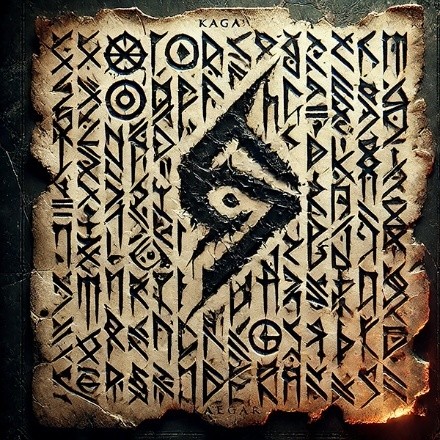
Most ominous among Aerias’s forgotten tongues is the dark speech of the kaegar – a language that carries power in its very utterance. Its words seem to distort the air itself, containing sounds physically impossible for modern throats to pronounce correctly. With consonant clusters and dual-tone vocalizations like “Vzk’rth” (Hunt/pursuit) and “Nzzt’krrv” (The void between worlds), it exists as much as threat as communication. Scholars note that the language contains subsonic elements affecting listeners on a physiological level, perhaps explaining the instinctive dread many feel in a kaegar’s presence. Such speech is rarely heard in the modern age, and when it is, wise folk turn away, for its guttural rhythms speak not merely of different words but of fundamentally different beings – predators whose very language marks them as other than those who now walk Aerias’s surface.
“Vzk’rth” – Hunt/pursuit (almost impossible to pronounce without the dual-tone vocal structure of a Kaegar)
“Ksht’grr” – Blood recognition/kinship
“Mrrk’thz” – Dominance/conquest
“Nzzt’krrv” – The void between worlds (their concept of sacred space)