
Technology
The Guild System
At the crossroads of innovation and tradition stands the Guild System—a sprawling network of specialized organizations that transcends political boundaries and racial divisions throughout Aerias. Neither bound exclusively to the Earthen kingdoms nor limited by conventional national borders, the Guilds represent perhaps the closest thing to a truly universal institution across the known world.
Emerging during the late Fourth Age as centers of specialized knowledge, the Guilds gradually evolved from loose associations of skilled practitioners into formalized bodies with standardized practices, certification processes, and eventually, significant political influence. What began as practical collaboration between craftspeople became the primary vehicle for technological advancement, with each major Guild developing its own hierarchy, traditions, and closely guarded secrets.
The Guilds’ true power lies in their ability to operate beyond the constraints that limit conventional authorities. A Guild Engineer might be born in Nevran lands, trained in Earthen academies, and implement innovations inspired by Dromelan principles—all while maintaining primary loyalty to Guild standards rather than any single kingdom. This trans-national character has allowed the Guilds to preserve knowledge through political upheavals, facilitate trade across hostile borders, and maintain technological continuity when other institutions falter.
Yet this independence comes with complexities and contradictions. While the Guilds officially welcome qualified members regardless of origin, practical access to their highest levels often reflects existing social hierarchies. Their standardization brings remarkable consistency to everything from medical treatment to weapon design, yet simultaneously suppresses traditional practices that fall outside their certification systems. They embody both meritocratic advancement and entrenched privilege, technological innovation and rigid orthodoxy.
For the average citizen of Aerias, the Guilds represent both opportunity and barrier—a pathway to prosperity for those who gain membership, and an imposing gatekeeper for those who remain outside their influence. Understanding this complex institution requires looking beyond their gleaming facades to the competing interests, ancient rivalries, and remarkable achievements that define their true nature.
Major Guilds
The Guild of Engineers stands as the preeminent technological authority, maintaining a careful balance between ancient magical principles and modern innovation. Their crystalline spires dominate urban skylines, housing laboratories where certified engineers develop everything from hover technology to communication systems. Guild certification marks the difference between “official” devices and street-level modifications, with prices to match this distinction. While they publicly dismiss “unauthorized practitioners” as dangerous amateurs, the Engineers quietly rely on these same individuals to access materials and perform services beyond official channels.
The Guild of Watchmen controls legitimate security operations throughout the Central Kingdom. Structured in rigid hierarchies from elite guards to common street watchers, they maintain order through officially sanctioned contracts and Guild-certified equipment. Unregistered security workers operate in a precarious space—tolerated in areas the Watchmen consider unprofitable, but swiftly suppressed when they encroach on lucrative territories.
The Guild of Medics synthesizes traditional healing arts with advanced medical technology. Their practitioners receive extensive training in both conventional medicine and specialized treatments for exotic conditions. The Medics guard their knowledge carefully, maintaining strict control over who receives advanced care and under what circumstances. Their archives contain extensive records of unusual medical phenomena, though access to these documents requires significant Guild standing or influence.
Structure and Hierarchy
Guild hierarchy maintains strict division between those within and without its structures:
Guild Masters occupy the pinnacle of authority, controlling certification standards and maintaining relationships with political powers
Senior Members manage day-to-day operations and specialized projects
Apprentices undergo rigorous training to earn certification
Associates perform licensed work under Guild oversight
Unauthorized Practitioners exist outside official structures, their skills ranging from barely competent to occasionally surpassing Guild standards
Influence and Economics
While technically separate from government authority, Guild influence permeates all levels of the Central Kingdom’s power structure. The Guild Masters’ Circle maintains no official seats in government, yet their control over technology, specialized knowledge, and trade networks makes them essential to the kingdom’s functioning. Each major Guild maintains liaisons to relevant government departments, creating a parallel power structure that often rivals traditional authority.
Guild economics operates on principles of exclusivity and certification. Official Guild products command premium prices justified by guarantees of safety and performance, while street-level alternatives provide functionality at significantly lower cost but without legal protection. This
dual economy creates distinct markets with minimal overlap, reinforcing social stratification throughout the Central Kingdom.
Technology and Politics
Guild technology has become inextricably linked to political power. The Separatist movement cultivates significant influence within Guild hierarchies, promising either reformed Guild authority or enhanced power depending on the audience. Meanwhile, the monarchy maintains traditional alliances with Guild Masters while quietly developing independent technological capabilities through the Immortals program.
This creates a complex web of competing interests:
Guild Masters protecting their traditional authority
Separatists exploiting Guild networks for political advantage
The monarchy balancing dependence on Guild resources with justified wariness
Knights of the High Kingdom selectively adopting Guild technology while maintaining independence
Street-level operators navigating between official structures
Weapons and Combat
Traditional Arms
Ancient weapons maintain relevance through both cultural significance and practical application. Knight-forged blades and traditionally crafted bows often incorporate materials resistant to modern energy weapons, making them surprisingly effective in specialized circumstances. The most revered traditional arms combine centuries of martial refinement with subtle Guild enhancements, creating weapons that serve as both practical tools and symbols of authority.
Traditional combat forms emphasize techniques developed over generations, particularly among the Knights and tribal warriors. These disciplines focus on harmonizing body, mind, and environment—skills that retain value even in an age of advanced weaponry. The most effective warriors master both traditional forms and modern combat methods, understanding when each approach offers tactical advantage.
Modern Weapons
Guild-certified modern weapons represent the pinnacle of publicly available armament technology. Energy-based systems dominate official military and security forces, with varying levels of sophistication:
NS-7 “Phantom” Resonance Pistol: Guild-engineered sidearm that creates sonic disruption waves on impact, capable of incapacitating targets through most armor. Features integrated thermal optics and secondary plasma mode for shield penetration.
VX-9 “Spectre” Tactical Sidearm: Advanced weapon utilizing quantum-stabilized rounds that phase through cover before re-materializing. Features adaptive harmonics in the barrel that learn from each shot, adjusting quantum frequency for maximum effectiveness.
Thunderlord Carbine: Heavy duty assault weapon with kinetic core technology, delivering concussive force along with penetrating rounds. Military-grade models feature recoil compensation systems and multiple firing modes.
Black Viper Repeaters: Rapid-fire weapons with serpentine recoil systems that maintain accuracy during sustained use. Commonly employed by Watchmen and private security.
Modern combat techniques emphasize tactical positioning, environmental awareness, and effective use of advanced weaponry. Guild training programs integrate these approaches with traditional discipline, creating hybrid combat methodologies that maximize technological advantages while maintaining fundamental skills.
Hybrid Technologies
The most sophisticated weapons in Aerias combine ancient principles with modern innovation. The Immortals’ arsenal exemplifies this approach, with each piece representing careful integration of traditional craftsmanship and Guild engineering:
Guild-Enhanced Blades: Traditional weapons infused with modern technology, capable of penetrating energy shields and defensive fields that resist conventional attacks
Soulsteel Armor: Ancient metals forged using traditional methods, then enhanced with Guild dampening fields and adaptive protection systems
Spirit-Linked Weapons: Specialized arms that synchronize with the user’s neural patterns, enhancing natural abilities through technological augmentation
Lorekeeper Archive Style:
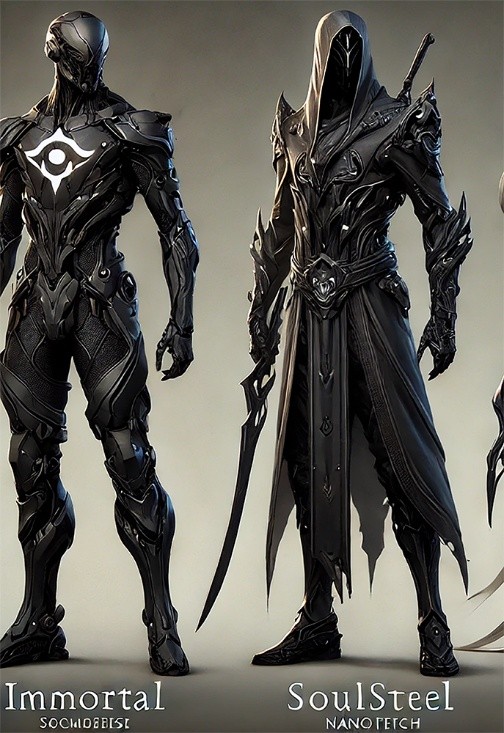
Side-by-side comparison of an Immortal Operative (left) and a fully armored Zylvan Knight of the Soulsteel Order (right). While both are equipped with adaptive nanoshell exo-armor, only Zylvan Knights carry the ceremonial Soulsteel, a symbiotic alloy believed to resonate with the wielder’s own echo signature.
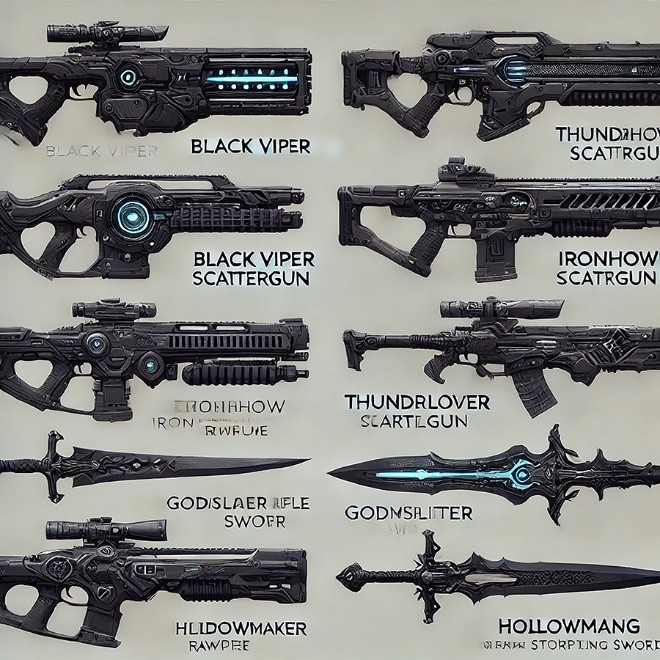
Classified inventory of hybrid weapons and modified firearms issued to Immortals and Knight-Guard operatives. Many are crafted from Obsidian Alloy or Echo-Tempered steel, calibrated for high-impact engagements with both mortal and non-mortal threats.
As one Guild Master noted: “A sword forged in dragon fire, tempered with Guild tech, and blessed by ancient rites isn’t just a weapon—it’s a testament to unified knowledge.”

Mask of Immortal
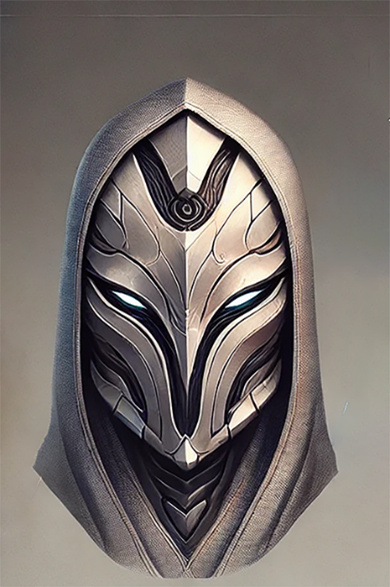
Mask of Zylvan Knight

Transportation
Hover Technology
Guild-certified hover vehicles dominate urban transportation in the Central Kingdom, creating multilayered traffic systems that maximize space utilization. These vehicles utilize crystalline power cores that interact with natural energy fields, generating sustainable lift with minimal environmental impact. Common variants include:

Aerglides
Sleek and elegant, Aerglides are the preferred mode of transit for Guild elites, dignitaries, and high-end merchants. Outfitted with advanced navigation systems, anti-theft shielding, and modifiable hull designs, they glide seamlessly above crowded urban avenues and tight corridors. Their reflective surfaces and whisper-silent engines make them as much a status symbol as a functional vehicle.
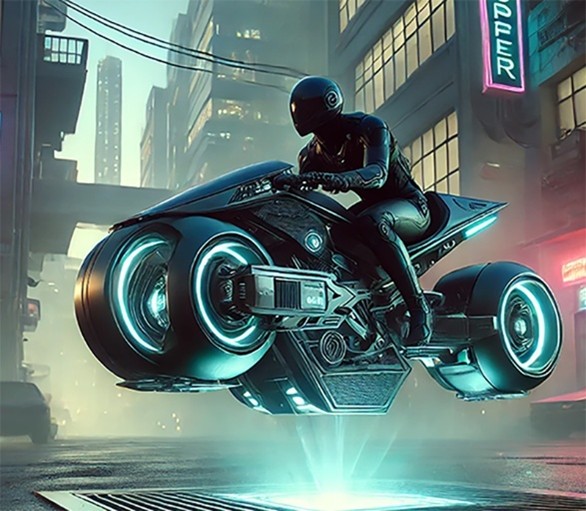
Drift Cycles
Engineered for speed and responsiveness, Drift Cycles are highly maneuverable single-rider vehicles that dominate the lower streets and back alleys of cities like Vesper. While favored by couriers and thrill-seekers, they’re also beloved by dissidents and young riders drawn to their rebellious, untamed energy. Many are custom-modded—some for style, others for escape.
Windchasers
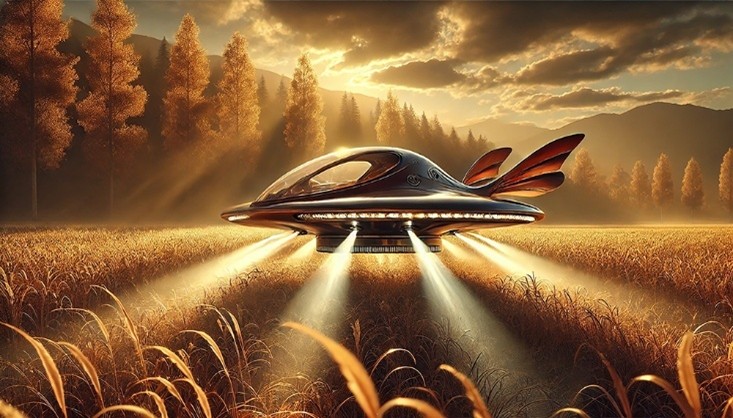
A harmony of form and function, Windchasers are Nevran-crafted vessels that blend polished hardwoods with aether-fused crystal propulsion cores. Built to resonate with the environment rather than overpower it, they glide above the grasslands and treetops with birdlike grace. Windchasers are sacred to the Eastern tribes and rarely seen outside Nevran borders.
Levants
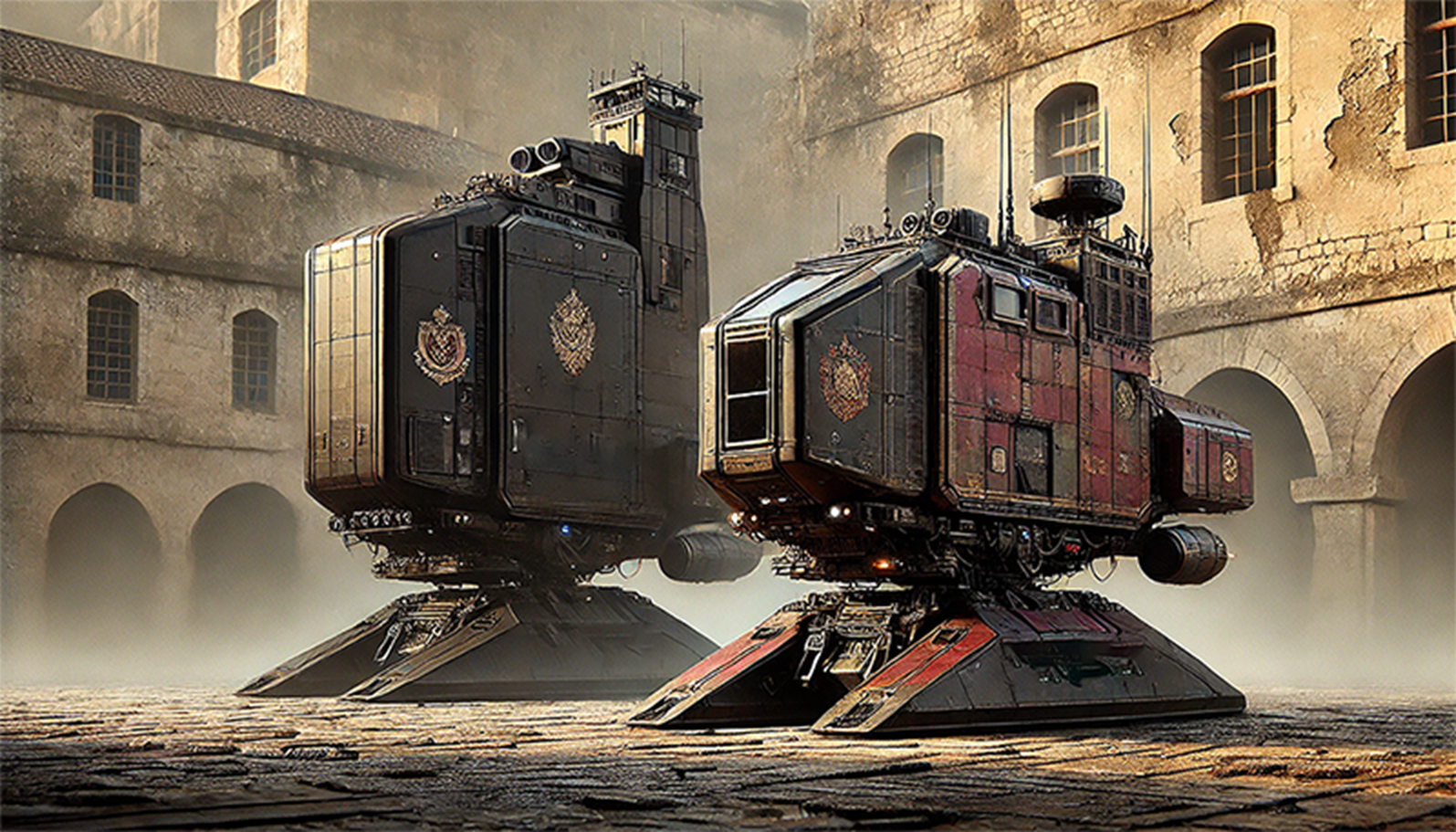
Towering and stately, Levants serve as the formal transports for governors, Guild liaisons, and foreign dignitaries across Aerias. Their reinforced exteriors and dampened propulsion systems offer a smooth, secure ride—while projecting power wherever they land. Most are emblazoned with the crest of their sovereign House or station.
Skimmers
Built for utility over flair, Skimmers are the dependable workhorses of Aerias’s agricultural and industrial sectors. While lacking aesthetic appeal, they are virtually indestructible, capable of long-haul travel across uneven terrain and harsh conditions. Farmers, engineers, and militia patrols rely on their longevity and low maintenance costs.
Figure 1: Left – Levant Diplomatic Transport | Right – Skimmer Utility Craft
Levi Train (Levitated Train)
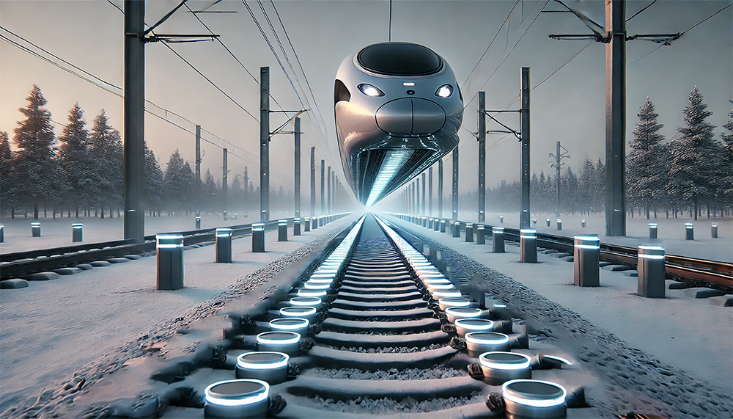
Developed by Guild engineers to traverse long distances at unmatched speeds, Levi Trains utilize a hover-based propulsion system driven by controlled magnetic polarity. Each car floats six feet above its guide rails, riding a field of repelling energy that pushes and pulls it forward using alternating charge pylons embedded in the track.
Unlike traditional rail systems, Levi Trains do not require physical contact with their tracks, making them ideal for harsh environments or unstable terrain. Their design allows them to maintain velocity even in snow-covered regions, as seen along the northern corridor routes. Civilian models offer comfortable, high-speed travel, while military variants are armored and reinforced for evasive maneuvers and tactical pursuits. In times of crisis, Levi Trains are often the fastest—and sometimes the only—means of escape.
Hover technology faces limitations in regions with natural or artificial dampening fields, areas of extreme electromagnetic activity, or zones deliberately kept free of Guild influence. These restrictions have preserved traditional transportation methods that might otherwise have disappeared.
Hydro Cruisers
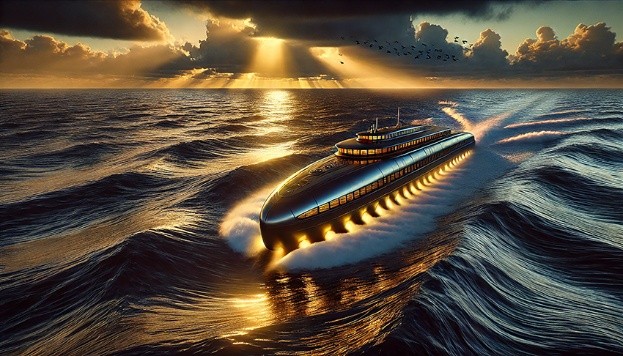
Maritime travel relies on hydro cruisers—advanced vessels that combine traditional hull design with sophisticated propulsion systems. These ships utilize Guild-engineered water displacement technology that reduces drag while maintaining stability, allowing for unprecedented speed across open water. Military variants feature reinforced hulls and integrated weapons systems, while commercial models emphasize cargo capacity and passenger comfort.
The North Sea trading routes depend entirely on these vessels, their specialized systems allowing navigation through waters too dangerous for conventional ships. Guild certification for hydro cruisers comes at premium cost, creating distinct classes of maritime travel based on technological sophistication and safety guarantees.
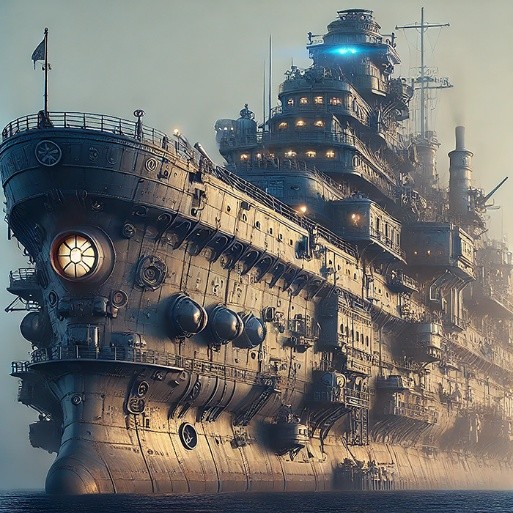
Juggernaut-Class Carriers
Built during the Iskari Conflicts, Juggernaut-Class Carriers—colloquially known as “Leviathans”—are massive, Guild-forged vessels designed for both endurance and intimidation. Their reinforced hulls and modular superstructures once housed mobile foundries, field hospitals, and barracks, making them floating fortresses during wartime. Today, many remain in service across Oravon as long-haul freighters, prison transports, or roving Guild outposts.
Unlike hydro cruisers, Leviathans are not designed for speed. They rely on slow but reliable steam-core drives and thick armor plating to survive the harshest of sea routes. Their hybrid power systems and retrofitted systems are relics of a bygone era—resilient, unsanctioned by modern Guild standards, and often still feared in remote waters.
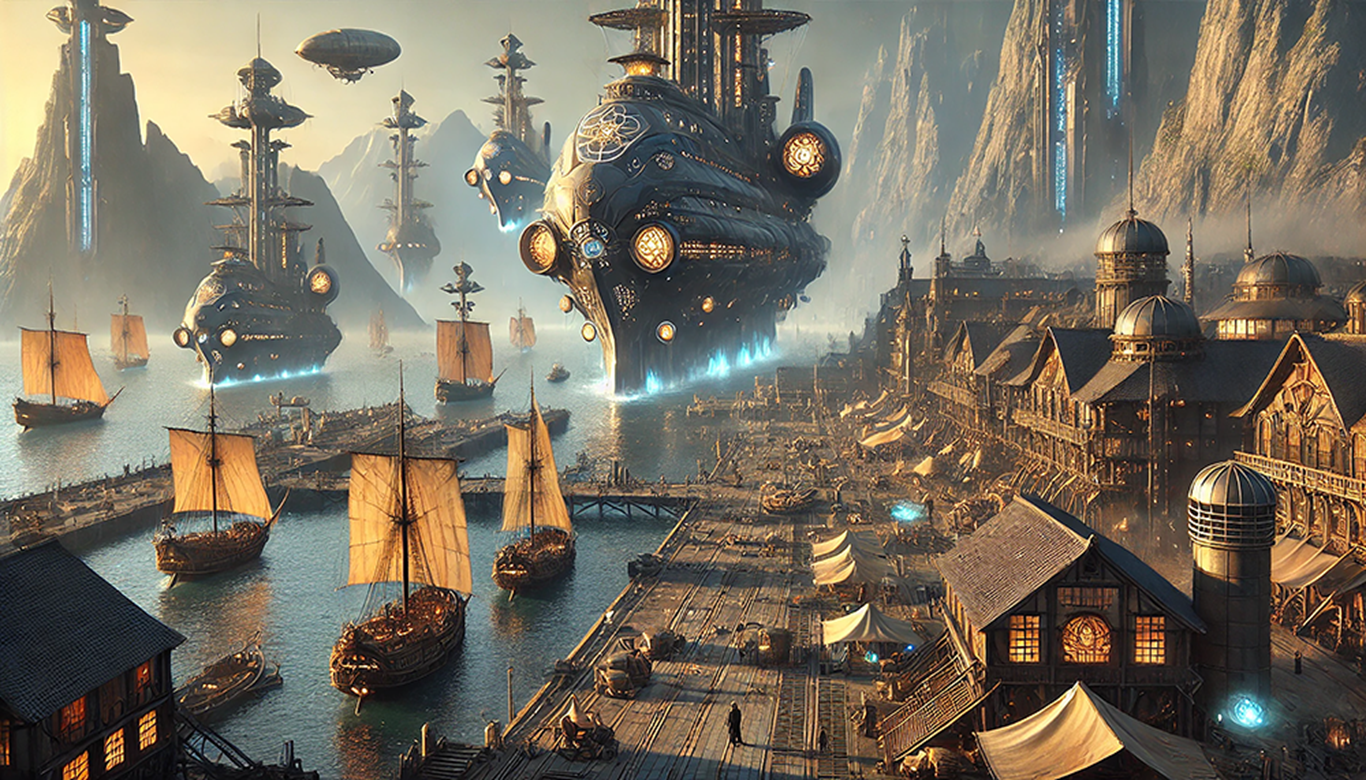
Thal’Zereth, Heaerea — A ceremonial port in the eastern Nevrish Kingdoms where Leviathans often make landfall. Towering cliffs and cascading light reflect the Nevrish ideal of order, tradition, and silent strength. Guild vessels are welcomed with cautious reverence, as their presence often signals more than trade.
Traditional Methods
Despite technological advancement, traditional transportation methods remain essential throughout Aerias. Hushners serve as the primary beast of burden in rural regions, their strength and intelligence making them ideal for agricultural work and overland transport. Carriage systems persist in areas where hover technology proves impractical or unnecessarily expensive, with Guild-enhanced variants offering improved performance without complete technological dependence.
The Knights of the High Kingdom maintain their traditional mounted cavalry, though these riders now train to operate alongside modern forces when necessary. This approach reflects the broader philosophy that guides Aerias’s most successful strategies—not abandoning proven methods for technological novelty but understanding how each approach complements the other in creating versatile, resilient systems.
Communications:
Guild Systems
Official communication relies on crystalline transmission networks maintained by the Guild of Engineers. These systems utilize carefully calibrated frequencies that allow near-instantaneous message transfer across vast distances, with security protocols that supposedly prevent unauthorized access. Public terminals operate in major urban centers, while private systems serve government facilities and wealthy institutions.
Guild communication technology extends beyond simple message transfer to include:
Data storage and retrieval networks
Real-time visual transmission systems
Encoded channels for sensitive communications
Emergency broadcast capabilities
The effectiveness of these systems depends entirely on proximity to Guild maintenance facilities, creating significant disparities between urban centers and outlying regions.
Traditional Methods
Traditional communication methods persist throughout Aerias, particularly in regions where Guild influence remains limited. Nevran communities maintain ancient messenger systems that rely on trained birds and spiritual connections, while rural settlements continue to use signal fires and courier networks. These approaches lack the speed and convenience of Guild technology but offer reliability independent of external infrastructure.
The most sophisticated traditional communications appear in Knight enclaves, where specialized training allows for message transfer through methods that predate Guild formation. These techniques remain closely guarded, ensuring communication options that function even when modern systems fail.
Hybrid Approaches
Practical necessity has led to widespread development of hybrid communication approaches. Many communities maintain both Guild terminals and traditional messenger systems, using each according to circumstance and need. Military forces particularly embrace this redundancy, training personnel in multiple communication methods to ensure operational flexibility.
This pragmatic approach reflects Aerias’s broader pattern—not choosing between tradition and innovation, but understanding how different systems can complement each other when integrated thoughtfully. As with weapons and transportation, the most effective communication strategies emerge from synthesis rather than separation, creating networks that draw strength from both ancient wisdom and modern ingenuity.