The People and Kingdoms
Nevran Realms
The Nevrans
From the eastern reaches of Aerias come the Nevran, a people whose very presence seems to echo the world’s first dawn. Their lavender skin catches light like morning mist, while their eyes hold the impossible blue of ancient skies. Though their bloodlines sometimes mingle with other races, producing subtle variations in their ethereal hues, they retain an otherworldly grace that speaks of their position as Aerias’s firstborn children. In them dwells a natural affinity for old powers, whether expressed through the martial discipline of Zylvan Knights or the quiet wisdom of tribal seers.
As the first mortal race to inhabit Aerias, the Nevrans hold unique cultural memories of the world’s pre-dawn era. Their traditions preserve the most extensive accounts of the Ilyrians (see Ancient Powers), with whom they shared Aerias before other species arrived. This historical connection has shaped Nevran spirituality, architecture, and cultural practices, distinguishing them from races who arrived after the Ilyrians had largely withdrawn from the physical realm
Zylvan Knights

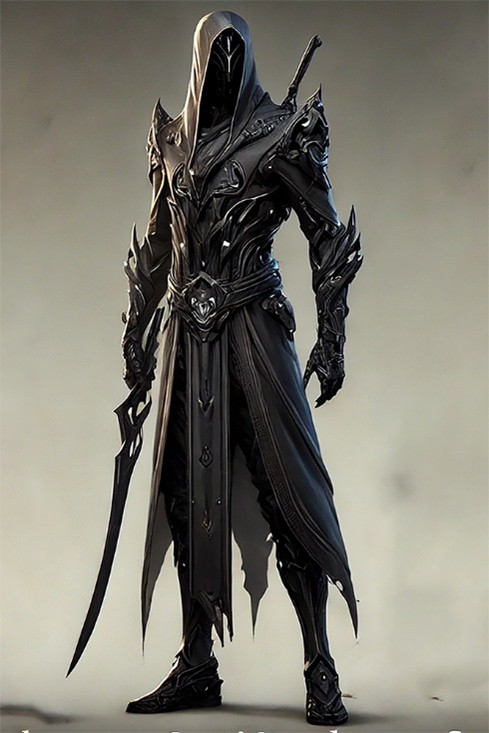
When starlight kisses the edge of a blade, when ancient oaths echo in the space between heartbeats, when duty and compassion become indistinguishable—there walks a Zylvan Knight. Neither mere warriors nor simple mystics, they are living bridges between Aerias’s luminous past and uncertain present.
Their journey begins with dreams touched by whispering winds—visions that pull the chosen from ordinary paths toward the Seven Trials of Attunement. Each challenge peels away another layer of worldly attachment until only essential truth remains. The final trial—the Night of Moonless Sky—reveals whether the supplicant’s inner light burns bright enough to illuminate the path ahead
Perhaps most sacred among their traditions is the lineage of knowledge, passed from father to son in an unbroken chain stretching back thirty generations. From the moment a boy reaches his seventh year, the training begins—not merely in combat forms, but in the spiritual disciplines that open one’s senses to the world’s deeper currents. The father shapes the son’s understanding through dawn meditations, twilight combat exercises, and midnight contemplations of the stars’ ancient wisdom. For those without sons, a sister’s child or Nevran orphan may be chosen, ensuring each generation carries forward what the previous has learned.
The rarest knights—those whose spirits resonate with particular clarity—undergo the Echo Bond ritual. Led by master Echo Smiths to sacred sites where the veil between worlds thins, these chosen few forge symbiotic connections with spirit beasts whose essence complements their own. The wolf’s preternatural senses, the eagle’s piercing sight, the mountain cat’s silent grace—all become extensions of the knight’s awareness, enhancing abilities that were merely human into something that approaches the realm of legend.
Those who emerge from these rituals don indigo robes threaded with silver that seems to capture fragments of starlight. Their Flowing Waters discipline appears as dance to untrained eyes while concealing martial techniques perfected through centuries of practice. When they move through village squares or royal courts, even children sense the difference—an aura of purpose that makes the air itself feel clearer in their presence.
A Knight’s touch can ease suffering; their word can end conflicts before blood is shed; their gaze can find truth where others see only confusion. Though the Zylvan Empire’s borders have shifted through ages, its Knights remain constant as the stars themselves—not relics of faded glory but living reminders that some lights never truly dim, so long as there are those with the courage to carry their flame forward.
From the journals of Archmaster Veilan, regarding unprecedented exceptions:
“Once in seven generations, the whispering winds may guide a Knight’s hand toward one who stands beyond our traditions. When this occurs—rare as twin eclipses—we must remember that the stars themselves sometimes choose vessels we would overlook. In the Third Age, Grandmaster Orith took an Earthen orphan as his student after seven nights of identical dreams. The boy later became Kaithron the Far-Sighted, whose actions during the Border Wars saved three provinces. The ancient powers recognize worthy vessels regardless of the blood that flows in their veins.”
Customs and Culture of the Nevran People
To understand the Nevran way is to learn the art of weaving—threads of ancient tradition interlaced with vibrant daily life, creating patterns that have sustained their society since before kingdoms rose. Their customs flow not from rigid dictates but from a profound rhythm aligned with Aerias itself, where even the simplest actions carry echoes of their five-millennium history.
Architecture and Settlements
Nevran settlements grow organically from the landscape rather than imposing upon it. Their structures rise in gentle tiers that complement natural contours, with walls alive with carefully tended moss and flowering vines. Unlike the cold steel and glass towers of Earthen cities, Nevran buildings breathe with the seasons—expanding slightly in summer heat, contracting against winter frost, their stone and living wood surfaces cool to touch even under the hottest sun.
As described by Guild Anthropologist Mareven: “A Nevran village appears, at first glance, to have been shaped by wind and water rather than mortal hands. Look closer, and you discover mathematical precision disguised as natural growth—load-bearing columns strategically placed to resemble ancient tree trunks, water systems that mimic stream beds while efficiently serving every household. It is architecture that refuses to announce itself, preferring instead to whisper its innovations.”
While this tale focuses on Nevrans living within the Central Kingdom and Oravon, their culture extends far beyond these borders. In their eastern homeland to the east, some Nevran communities in the Zylvan region have embraced Guild technology while maintaining their cultural identity, creating cities that blend ancient aesthetics with modern innovation. Further east, across the great plains of Myzara, nomadic Nevran tribes preserve traditions unchanged since the First Age, their ways offering a window into the earliest days of their civilization.
Markets and Commerce
The Nevran marketplace embodies their cultural spirit—vibrant, communal, and seeming chaotic to outsiders while following deeply intuitive patterns. Stalls arrange themselves not by guild regulations but by relationships forged over generations, with vendors positioning themselves near those whose goods complement their own. Morning prayers precede trading, with merchants asking blessings not for profit but for the strength to serve their community well.
Prices remain remarkably consistent throughout the day, as bargaining focuses less on reduced costs and more on adding complementary items to create a balanced exchange. A bread seller might maintain her price but include fresh herbs to a regular customer, while a cloth merchant adds decorative thread to a fabric purchase. These “harmony additions” exemplify the Nevran belief that true value lies in relationships rather than coin.
The market itself breathes with the settlement’s rhythm—expanding into neighboring streets during festival times, contracting to essential stalls during planting season when many hands return to fields. Within this flow, traveling merchants receive welcome spaces, bringing exotic goods while respecting local customs by adopting traditional local greetings and observing proper exchange rituals.
Hospitality and Home
Perhaps no aspect of Nevran culture proves more sacred than their hospitality traditions. To welcome a stranger beneath one’s roof is to assume responsibility for their comfort, safety, and spiritual well-being. The threshold crossing carries ceremonial weight, with guests receiving customary clothing to wear during their stay—garments that symbolically incorporate them into the household’s protection.
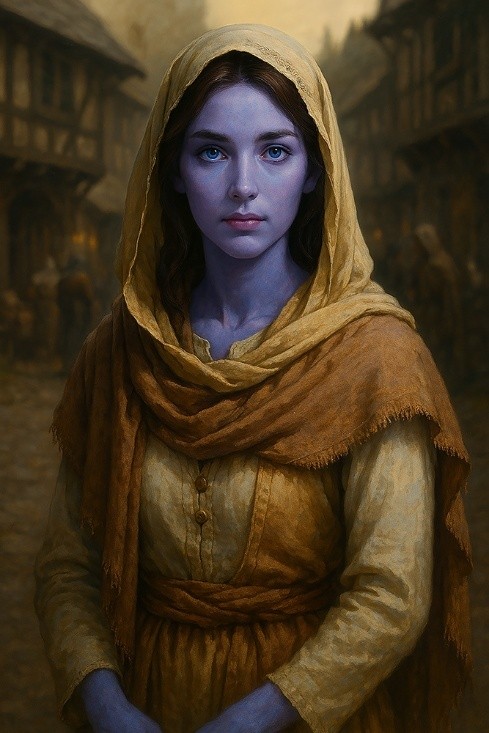
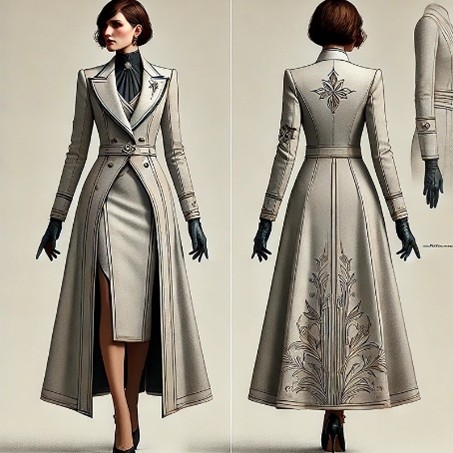
Liyzia of Orwein (Artist’s Interpretation)
Often mistaken for humble, the rural women of Orwein possess a quiet fortitude. Their garments are utilitarian, yet the folds and fastenings reflect deep spiritual codes. In uncertain times, even the gentlest hand may carry the weight of prophecy.
Archive Tag: [Orwein Record – Civilian Profile: NV-328-LY]
Classification: Tier 2 – Confirmed Ethnographic Sketch, Zylvan Lowlands
From the moment a guest enters, they become family in all meaningful ways. Their preferences are anticipated, their comfort prioritized, and their presence honored through elaborate meals where refusal of offered food would constitute grave insult. House matrons orchestrate these feasts with generations of accumulated wisdom, each dish placed strategically to complement not just flavors but symbolic meanings. As the Earthen scholar Terazin observed: “A Nevran dinner table becomes a map of relationships—sweet dishes placed near bitter ones to balance the palate, darker broths beside light fruits to please the eye, older family members seated across from younger ones to encourage wisdom’s transfer.”
Children in Nevran households move with surprising freedom, their enthusiastic chaos viewed not as disruption but as essential energy that keeps a home vibrant. Yet this apparent permissiveness masks careful instruction in cultural values, with each game and children’s chant embedding lessons about community responsibility and cosmic harmony.
Clothing and Adornment
Nevran traditional dress embodies their philosophy of practical beauty. Their garments flow in layers that adjust to changing temperatures, with interchangeable components for different seasons or occasions. The most revered items are family shawls—heirloom textiles that record matrilineal heritage through intricate patterns woven with threads dyed from plants gathered by successive generations.
These shawls pass from mother to eldest daughter in an unbroken chain, each woman adding her own contribution to the living tapestry before passing it to the next generation. The daughter learns the weaving techniques from childhood, studying the patterns that came before while contemplating what her own addition will someday be. These shawls serve as living documents more precious than written records. Each symbol within the weave tells family stories—a subtle lattice pattern marks a generation that survived great drought; a repeated flower motif celebrates a line of notable healers; a distinctive border pattern indicates connections to particular villages or noble houses. The most ancient shawls, some dating back sixty generations, incorporate threads spun from plants now extinct, their patterns preserving botanical knowledge otherwise lost to time.
The gifting of such a shawl to an outsider—especially from a matriarch with no daughters of her own—represents a profound adoption, literally weaving the recipient into family history. Such events occur perhaps once in a generation even within Nevran communities, making them subjects of songs and stories. For oustider to receive such recognition is virtually unprecedented, marking them as something extraordinary in the eyes of all who recognize the patterns. The recipient becomes, in all meaningful ways, a child of the house—doubly significant when the matriarch might otherwise have no heir to continue her shawl’s journey through generations.
Language and Communication
While many Nevrans speak the Common Tongue fluently for commerce and diplomacy, their heart-language remains Nevrish—a melodic tongue whose subtle inflections can express concepts requiring full paragraphs in other languages. Even modern Nevrish preserves grammatical structures dating from the First Age, with seven tenses for describing past events based on their relevance to present circumstances.
More formal settings demand High Nevrish, primarily used in ceremonies and scholarly contexts. Its intricate honorifics reflect not just social standing but the spiritual resonance between speakers—terms change based on shared experiences, moon phases during significant encounters, and even mutual recognition of natural omens. To outsiders, this appears as bewildering complexity, but to Nevrans, it simply acknowledges the living web of connections that surround every interaction.
Most remarkable is the enduring tradition of Nevran sign language, originally developed to communicate with Ilyrians and other Pre-Dawn beings. These elegant hand movements preserve concepts otherwise inexpressible in verbal language—particularly those relating to spiritual perception and connections between realms. Though rarely taught to outsiders, these signs sometimes appear in moments of profound emotion, when words alone cannot carry meaning’s full weight.
Spiritual Practices
Nevran spirituality defies simple categorization, existing as neither formal religion nor casual superstition but rather as seamless integration between physical and metaphysical awareness. At its core lies reverence for the Almighty Source—that first light from which all creation flows—while honoring the echoes of that divinity that remain in Aerias through the Ilyrians’ lingering influence.
They recognize no division between sacred and secular—every meal begins with gratitude to the Almighty, every journey acknowledges the paths others have walked before, every significant decision invites reflection on how it might affect seven generations hence. Their calendar marks cosmic alignments when the veil between realms grows thin, occasions for deeper communion with both the Source and its physical manifestations.
Their practices center around discerning listening—to natural rhythms, to ancestral whispers, to the subtle currents that flow between all living things. Dawn meditations attune the senses to coming day’s possibilities, while evening reflections honor what has passed. Each Nevran home maintains a small altar where the family gathers for daily communion, though these spaces serve reflection rather than ritual obligation.
Most settlements maintain a Quiet Place—not a temple in the common understanding, but a space where the boundary between worlds grows permeable. These locations, chosen through careful observation over centuries, feature distinctive acoustic properties and often unusual plant growth. Here, seers interpret the “whispering winds”—currents of knowledge that flow through all living things, allowing communion with the natural world itself.
Their famed hospitality stems from ancient teachings that benevolent beings might walk among mortals, testing their hearts through unexpected visits. A Nevran host therefore approaches each guest with discerning respect—attentive to both the visible person and potential spiritual presence they might carry. This practice carefully distinguishes between welcoming beings of light and maintaining vigilance against deceptive forces that might seek entry through careless invitation.
For Nevrans, spirituality serves as the warp threads through which all other cultural elements weave. Their architecture honors the land’s inherent energies; their economic exchanges balance material and immaterial gifts; their creative expressions seek harmony with natural rhythms. To understand Nevran culture fully requires seeing with more than eyes alone—opening oneself to possibilities that rational frameworks often reject, yet that have sustained this remarkable people since the world’s first dawn.
Social Roles:
The Matron
Among the Nevran people—particularly in rural settlements such as Orwein—the Matron serves as both a cultural anchor and moral compass. She is not a formal authority figure, yet her influence shapes daily rhythms, intergenerational teachings, and quiet decision-making. Matrons often preside over births, naming ceremonies, seasonal gatherings, and rites of remembrance, stepping into the spiritual void when a Seer is absent or withdrawn.
Clad in layers passed through generations, the Matron carries the weight of ancestral memory, often communicating through gesture, parable, or silence more than decree. Though frequently underestimated by outsiders, her voice within Nevran households is absolute—and her absence is often felt more sharply than her presence.
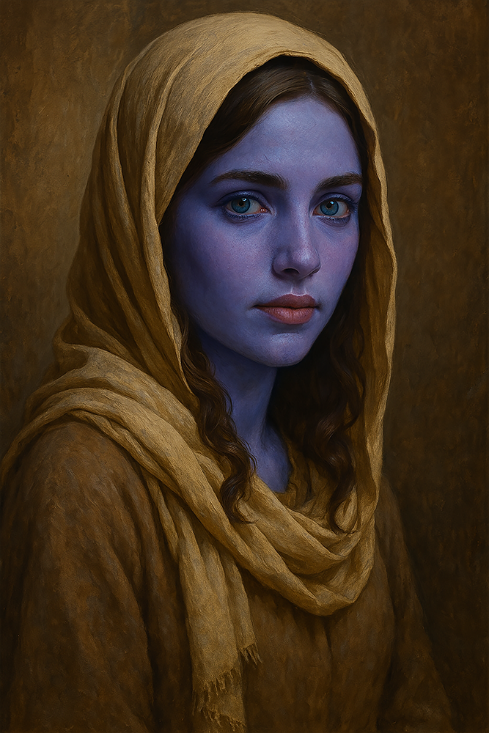
Nevran Matron, Orwein Region
Adorned in traditional veil-wrap and embroidered cloak, women of the Orwein highlands carry their lineage not in jewels, but in the stitching of their garments. The lavender hue of her skin and glacial-blue eyes mark her as highborn—descended from ancient Zylvan bloodlines that once held the veil of the eastern passes.
Archive Tag: [Cultural Reference – Zylvan Matrons, Northern Fold]
Classification: Tier 3 – Lineage Reference | Noble Descent, High Nevran
The Seer
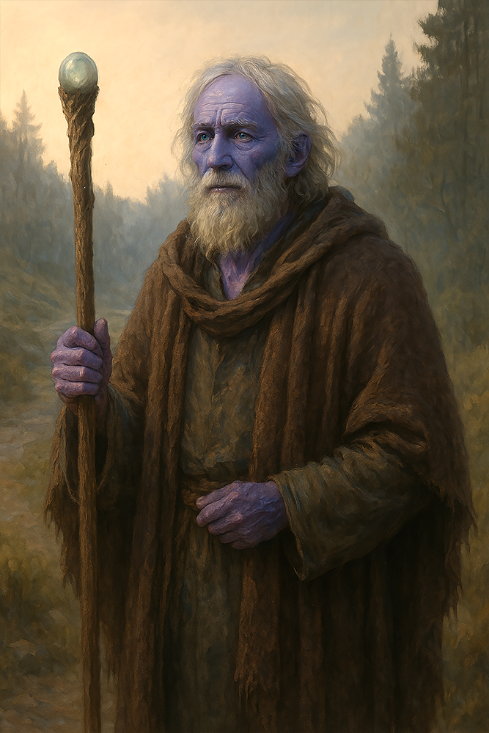
A gifted individual among the Nevran people who serves as interpreter of natural signs and vessel for ancestral wisdom. Unlike scholarly practitioners who study omens methodically, true seers possess an innate connection to what Nevrans call the “whispering winds”—currents of knowledge that flow through all living things, allowing communication with the natural world itself. When ancient powers stir, even the trees and stones respond, a phenomenon seers can detect long before others. Stories hint at far more profound abilities among the most gifted seers, though such powers are rarely witnessed in the modern age.
Their abilities often manifest in childhood through prophetic dreams or unusual sensitivity to natural phenomena. While their methods appear mystical to outsiders—reading patterns in falling leaves, interpreting animal behaviors, or listening to “voices” in flowing water—seers themselves describe their practice as simply a heightened form of paying attention to what the world freely reveals. Many maintain sacred spaces where the boundary between physical and spiritual realms grows thin, though some, like Finnor of Orwein, walk among their communities as advisors and healers. In modern times, their influence has waned in urbanized regions but remains profound in tribal territories and rural communities.
Nevran Seer – Orwein Region (Undocumented Witness)
Though rarely named in official records, the Seers of Orwein walk paths older than memory. Unburdened by title or ornament, they serve not as prophets, but as interpreters—reading the land, the wind, and the unseen rhythms of the world. When they speak, it is not to command, but to remind. Their presence is both comfort and omen.
Tier 1 – Living Witness Classification The Central Kingdom
The Earthans
If the Nevran reflect Aerias’s ancient dawn, the Earthen embody its vibrant noon. Their varied hues span the full spectrum of earth’s rich palette, from deepest umber to palest ivory. This diversity mirrors their adaptable nature – they are innovators and dreamers, builders and seekers, equally capable of crafting crystalline towers or preserving ancient traditions. In their hands, the Immortals’ ancient duties blend seamlessly with modern governance, while their engineers forge paths between mystical past and technological future.
Though officially named for its geographical position at the crossroads of ancient trade routes, scholars note the subtle irony in a kingdom that calls itself ‘central’ while experiencing such profound internal divisions.
Political Structure
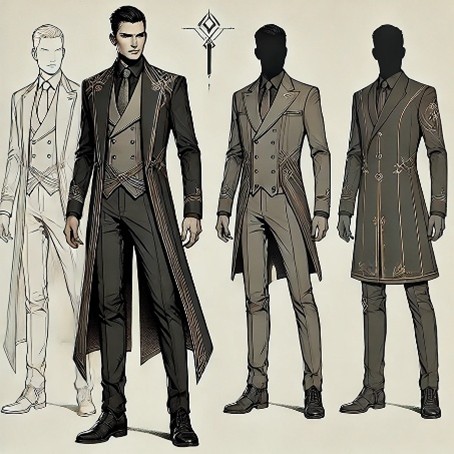
The Central Kingdom stands as a testament to Earthen pragmatism—a civilization that has crafted governance through both ancient tradition and calculated innovation. At its apex stands the High Council, a triumvirate of power where monarchy, military, and senate engage in a delicate dance of authority and constraint.
The monarchy remains the kingdom’s beating heart, its bloodline stretching back to the earliest days of unification. Through royal decree and ancient right, the sovereign shapes laws that guide the realm while preserving traditions that have weathered centuries of change. The aether stone at the monarch’s throat serves as both symbol and proof of legitimate rule—its subtle luminescence responding to bloodlines that carry authority no Senate vote can bestow.
Standing as the throne’s sword and shield, the Military Council unites the kingdom’s seven highest generals in service to crown and country. These warriors answer only to royal command, their loyalties secured through oaths that transcend political fashion. Their counsel shapes defense strategies and border policies while their forces guarantee the peace that allows commerce to flourish. In times of crisis, when Senate debates would cost precious hours, these commanders move with decisive swiftness, their authority flowing directly from the sovereign they’ve sworn to protect.
The Senate provides the kingdom’s third pillar—sixteen representatives whose power flows from the cities and districts they serve. Though lacking the military’s swift action or the monarchy’s ancient authority, these elected officials translate common concerns into legislative action, ensuring that royal decrees remain connected to the people they govern. Through careful negotiation and coalition-building, the most influential senators have transformed district concerns into kingdom-wide policies, sometimes reshaping the very nature of governance itself.
This tripartite structure has maintained relative stability for generations, though beneath its ordered surface, currents of change continue to gather strength. Recent decades have seen the Senate’s influence grow while regency protocols constrain traditional royal authority—creating opportunities that ambitious figures like Senator Hans Lumen have been quick to exploit. As Princess Aylin approaches her coronation, these political tensions form the backdrop against which personal ambitions and ancient powers converge, threatening foundations that once seemed unshakable.
The Separatist Movement

The movement that calls itself “Separatist” originated not in sweeping revolution but in conference rooms and university debates—a framework of political theory that has steadily crystallized into the most significant challenge to monarchical authority in five centuries. Their central thesis, crafted in meticulous policy documents and impassioned speeches, contends that governance legitimized through bloodline has become incompatible with the realities of modern innovation and social complexity.
At its noblest, the Separatist platform represents a coherent vision for transforming the Central Kingdom into a democratic republic, with leaders elected through merit rather than birth. Their manifestos outline systems of checks and balances, regional representation, and transparent governance that have attracted support from intellectuals, guild masters, and reform-minded aristocrats alike. Senator Eloria Vayne, whose family holds ancient ties to the throne she now questions, advocates for this position with eloquence that even her opponents grudgingly respect: “We seek not to destroy tradition but to evolve it—preserving what serves our people while replacing what merely serves power.”
Yet beneath this principled veneer operates a more pragmatic machine. The movement’s financial backbone consists largely of Guild financiers and industrial magnates whose motives blend idealism with naked self-interest. For many, democratic reforms promise freedom from royal taxation and regulatory oversight that has constrained profit margins for generations. The Guildmaster’s quarterly gatherings, ostensibly focused on economic policy, increasingly feature Separatist speakers whose rhetoric carefully balances democratic principles with promises of “unleashed prosperity.”
Most concerning to traditional power structures is the movement’s growing influence within the Senate itself. While officially pledging loyalty to the crown, nearly half of junior senators now align with Separatist caucuses. Some, like the charismatic reformer Bail Haldred, operate in full public view, crafting legislation that incrementally transfers authority from throne to chamber. Others work more subtly, embedding Separatist principles in seemingly innocuous administrative codes and regulatory frameworks.
The Immortals

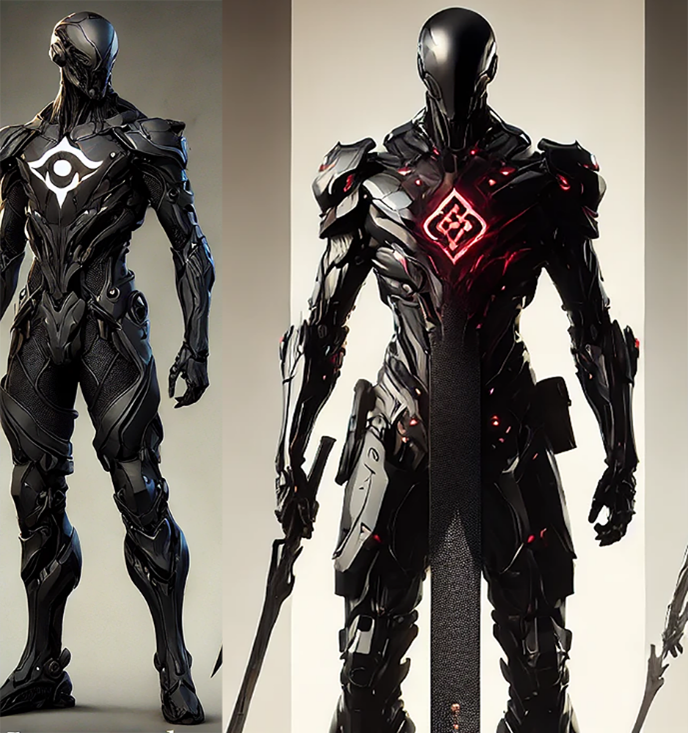
Established in 4221 N.C. following the Third Zylvan War, the Immortals constitute the Central Kingdom’s elite protective force, sworn directly to the crown rather than any governing council. Selection occurs between ages eighteen and twenty-two, with candidates undergoing the Trial by Fire—a series of increasingly demanding physical and psychological evaluations designed to identify not merely strength but calculated decision-making under extreme duress.
Distinguished by their obsidian armor—a Guild-engineered alloy whose manufacturing process remains classified—Immortals maintain a strictly regimented existence. They take vows of celibacy and singular dedication for their service term (minimum fifteen years), ensuring undivided loyalty to throne and realm. Combat training emphasizes precision, efficiency, and adaptability to modern weaponry while preserving traditional martial foundations.
Statistical analysis confirms their effectiveness: no monarch guarded by a full Immortal contingent has fallen to assassination in the 5,421 years since their formation. Their strategic deployment has proven instrumental in seventeen major conflicts and forty-three territorial disputes, with documented casualty reduction of 37% compared to conventional forces.
Upon honorable completion of service, Immortals may retire to training or advisory positions, though 76% choose to extend their active duty beyond minimum requirements. The selection process accepts approximately 4% of applicants, maintaining optimal force strength between seventy and ninety active members at any given time.
Earthen Culture and Society
The Earthen society that dominates the Central Kingdom presents itself as a triumph of innovation—a civilization that has mastered the delicate balance between technological progress and traditional values. In the kingdom’s official narratives, crystalline spires and hover lanes represent not just engineering prowess but the culmination of a cultural philosophy that embraces change while honoring stability. This carefully cultivated image contains truth, yet reveals only the topmost layer of a stratified society whose complexities run deeper than the ancient foundations beneath its gleaming capital.
At its zenith stand the High Houses—families whose connections to the throne trace back to the earliest days of unification. Their children attend academies where hovercrafts and estate management receive equal emphasis, where diplomatic protocol and traditional sword forms share curriculum space with quantum theory and Guild economics. They move through life in seasonal migrations—winters in city penthouses, summers on ancestral estates, festival seasons at coastal retreats where servants outnumber family three to one. The Dravens, Mercurys, and Orlovs of these storied bloodlines interpret themselves as living bridges between past and future, upholding what they term “civilizational continuity.”
Below them spreads a prosperous professional class—Guild Engineers whose innovations power the kingdom, Senate administrators who translate policy into practice, merchants whose trade networks connect distant territories. Their districts feature modernized architecture with traditional facades, where crystal-powered conveniences lie behind carved wooden doors. Their children pursue careers that balance security with ambition, while their social gatherings blend modern entertainment with ceremonial customs that echo royal court traditions. For them, the Central Kingdom represents opportunity within structure—freedom to advance without revolutionary disruption.
The narrative grows more complex in manufacturing districts where hover components and Guild technology take form. Factory workers and technical specialists occupy the urban middle—neither impoverished nor truly comfortable, their lives shaped by guild regulations and production quotas. Their neighborhoods maintain reasonable safety and functional infrastructure, though rarely receive the architectural attention or civic investment of wealthier districts. Unlike their Nevran or Dromelan counterparts, most Earthen citizens in this stratum view their condition as temporary rather than hereditary—a stepping stone toward eventual ascension through merit or fortunate connection.
Yet beyond these relatively stable layers exists another reality entirely. In harbor districts and industrial zones, on urban peripheries and in the shadows of gleaming towers, survival replaces aspiration as daily focus. Here, Guild prosperity manifests primarily in waste and runoff—technological discards repurposed through necessity into makeshift shelters and improvised tools. Forgers, watchmen, and countless others navigate environments where official protection extends only to property rather than people, where authorities appear primarily to enforce rather than serve.
What distinguishes Earthen culture from its Nevran or Dromelan counterparts is not simply technology but this fundamental tension between unity and division. While presenting a coherent national identity to external powers, internally the kingdom operates as multiple societies occupying the same geographical space while experiencing profoundly different realities. The official culture venerates both innovation and tradition, yet the benefits of each flow primarily upward while consequences predominantly trickle down.
This divided experience manifests most visibly in Earthen creative expression. Their literature simultaneously produces pastoral romances celebrating timeless values and gritty urban narratives chronicling systemic corruption. Their visual arts span classical portraiture of High House dignitaries and underground exhibitions depicting industrial desolation. Even their religious practices reflect this duality—grand ceremonies in capital temples occurring alongside makeshift shrines in factory districts where workers pray for practical intervention rather than cosmic harmony.
Perhaps most telling is the kingdom’s architectural language. The famous crystal spires of the capital rise from foundations built centuries earlier, their transparent beauty supported by stone substructures that remain invisible to casual observers. This physical reality mirrors the cultural one—a society whose gleaming achievements rest upon layers of history, labor, and struggle that official narratives acknowledge only in carefully curated forms.
To truly understand Earthen culture requires recognizing this fundamental duality—a society simultaneously defined by remarkable adaptability and profound stratification, by technological miracles and systemic disparities, by aspirational narratives and contradictory realities. Like the hybrid technologies that power their cities, Earthen society itself represents an ongoing experiment in containing opposing forces within a single, complex system.
Skylanders
A distinct offshoot of Earthen stock dwelling in the harsh northern frontier beyond the Central Kingdom’s formal borders. Their territories—known collectively as the Skylands—encompass frigid tundra, storm-lashed valleys, and jagged highlands unsuited to the Kingdom’s structured expansion.
Society and Governance
Unlike the Central Kingdom’s hierarchical structure, Skylander settlements (called Steadings) operate as self-governing enclaves led by councils of experienced tradespeople, mechanics, and fighters. Between these settlements lie the dangerous “Gaps”—lawless stretches where drifters and raiders prey on unprotected travelers
Technology and Adaptation
Skylanders employ a pragmatic blend of scavenged Guild technology, traditional tools, and improvised innovations. Their approach favors function over form, resulting in hybrid creations that might horrify Guild Engineers while perfectly serving frontier needs. Pulse rifles operate alongside hand-forged blades, and jury-rigged generators power settlements where official infrastructure never reached.
Relations with the Central Kingdom
The Kingdom maintains Transition Zones—heavily fortified trading outposts where Skylanders can legally exchange furs, rare minerals, and frontier goods for manufactured supplies. Beyond these supervised hubs, relations often devolve into raiding and counter-raiding, with Skylander crews targeting supply caravans while Kingdom patrols attempt to maintain order.
Cultural Identity
Though Earthen by blood, Skylanders have developed a distinct cultural identity forged in frontier hardship. Their songs celebrate survival against overwhelming odds, their art adorns weapons and vehicles rather than galleries, and their faith honors the practical forces that govern daily life. Where Central Kingdom Earthans balance tradition with innovation, Skylanders weld them into a single tool of survival.
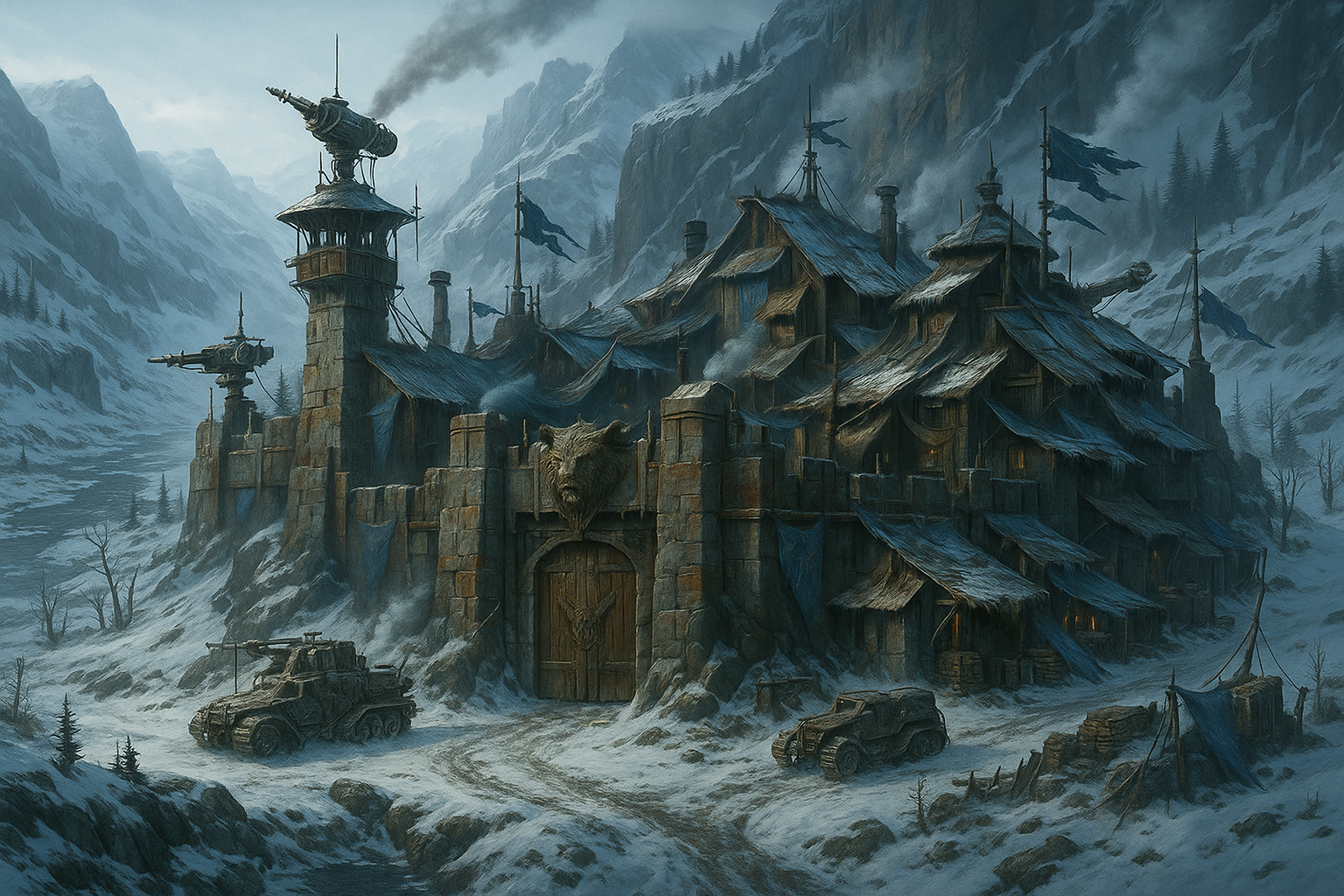
“You’ll see it before you feel it – a black silhouette rising from the white horizon, half swallowed by the snow. They call it Stonewatch. The Skylanders built it after the Winter of Wolves, when the Gaps grew too dangerous for lone caravans. Don’t expect welcome banners; they size you up before the gates even open. Still, once inside, you’ll find warm fires, barter tables heavy with fur and metalwork, and eyes that never stop measuring you. The walls hum with patched-up Guild tech, and every corner hides a rifle or blade ready to meet trouble. It’s not a place for soft hands or soft hearts, but if you need shelter before braving the Skylands, Stonewatch will hold the line.”
— Journal of Hadrien Voss, Caravan Quartermaster
The Dromelan Empire
Dromelans
If the Nevran embody dawn and the Earthen represent noon, then the Dromelans are Aerias’s twilight—figures of imposing shadow and enduring mystery. Their skin carries the deepest purples of dusk, marked with ancestral patterns that record lineages older than many kingdoms. Taller than their Earthen cousins and more angular than Nevran neighbors, Dromelans move with deliberate purpose, each gesture carrying the weight of tradition. They are a people who remember when stars spoke directly to mortals, who preserve knowledge others have forgotten or deliberately buried. In their northern empire, crystal-forged towers rise alongside ancient temples, while beneath both lie secrets that have survived five millennia of careful guardianship.
Imperial Structure
The Empire of Thrakasmeir stands as both geographical and cultural counterpoint to the Central Kingdom—a realm where stark beauty and harsh reality forge a society unlike any other in Aerias. From its towering capital of Khor’mandras, carved into ancient volcanic mountains, the Empire extends across territories reminiscent of tundra landscapes broken by seasonal thaws and surprising agricultural ingenuity.
Imperial governance flows through a rigid hierarchical structure, with the Sovereign Council maintaining central authority while regional Dominions enjoy limited autonomy. Unlike the Central Kingdom’s blend of tradition and innovation, Thrakasmeir embraces a philosophy of endurance and preservation—their societal structures having remained largely unchanged for millennia, a fact their historians cite with pride rather than concern.
The Dromelan people themselves defy simple categorization. Travelers often expect harshness to match their environment, yet discover communities known for their hospitality, artistic traditions, and profound philosophical discourse. Their distinctive appearance—ranging from dusky blue to gray-violet skin tones and eyes that capture light differently than other species—makes them immediately recognizable throughout Aerias, though their internal social distinctions remain opaque to outsiders.
The Sect
Among the most controversial elements of Dromelan society, the religious organization known simply as “The Ticurin Sect” represents both tradition and dissent within imperial structures. Officially denounced by imperial authorities as dangerous separatists, their influence nonetheless extends through shadow networks across Thrakasmeir and beyond.
Unlike political separatists who seek governmental reform, the Sect pursues objectives rooted in ancient religious beliefs—specifically, restoration of what they term the “original order” that existed before the Great Sundering. Their sacred texts speak of returning Aerias to its “proper balance” through rituals and practices officially forbidden within imperial territories.
Most concerning to neighboring kingdoms is the Sect’s rumored obsession with kaegar lore. While imperial authorities maintain that such knowledge was purged centuries ago, persistent reports suggest Sect leadership preserves forbidden texts containing details about these ancient entities—including potential means of controlling or awakening dormant specimens, if any truly remain.
The Sect’s actual capabilities remain largely unknown to outside observers, their activities cloaked in layers of secrecy and misdirection. What little information reaches official channels suggests an organization equipped with both traditional mystical practices and sophisticated modern resources—a dangerous combination that has sparked quiet concern among those aware of their existence.
Certain ancient Dromelan texts suggest a symbiotic relationship between specific sects and the Kaegar, though the nature of this connection remains one of history’s most closely guarded secrets. What little evidence survives indicates these sects possessed means to both awaken and direct these entities—knowledge that led to their eventual exile from imperial society.
Culture and Technology
Dromelan technological development follows a distinctive path—neither embracing Guild innovation with Earthen enthusiasm nor preserving Nevran traditions unaltered, but instead pursuing technological self-sufficiency through methodical adaptation. Their engineers favor reliability over novelty, creating systems that function independently of Guild supply networks and certification structures.
This approach produces artifacts instantly recognizable as Dromelan work—communications devices with century-long operational lives, weapons systems that function flawlessly in environmental conditions that disable Guild equivalents, and architectural achievements that blend seamlessly with their harsh natural surroundings. Most distinctive is their approach to power generation, utilizing geothermal and crystalline technologies developed independently from Guild research paths.
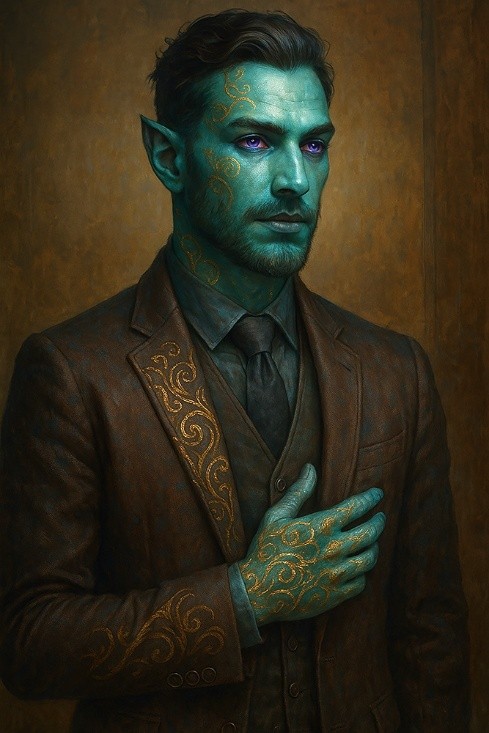
Dromelan Emissary – Identity Unconfirmed
Marked by ceremonial gold tattoos and glacier-borne skin, emissaries of the Dromelan Kingdom are seldom seen beyond the southern embassies. Their attire reflects a tradition steeped in silence and shadow—tailored not for fashion, but for power without noise. The eyes, often red or violet, are said to see through deception and memory alike.
Cultural expressions reflect similar principles of endurance and adaptation. Their music employs distinctive harmonic structures that create emotional responses across species barriers, while their literary traditions emphasize historical narratives that connect present communities to ancient heritage. Most renowned are their philosophical schools, whose emphasis on balance between material existence and spiritual awareness attracts scholars from across Aerias despite imperial restrictions on cultural exchange.
For most citizens of the Central Kingdom, direct experience with Dromelan culture remains limited to diplomatic exchanges and merchant interactions. The true complexity of this ancient society—its internal divisions, philosophical depths, and technological achievements—remains largely hidden behind geographical barriers and political tensions, creating fertile ground for both admiration and suspicion among those who glimpse only fragments of a civilization as old as Aerias itself.
Other Notable Races/Species
The Myrexians
Physical Traits: Slender and graceful with distinctive iridescent skin that shifts between deep blues and emerald greens depending on emotion and light. Their most striking feature is a natural crest of crystalline growths along their spines that refract light in mesmerizing patterns. Standing slightly shorter than the average Earthen, they move with deliberate precision.
History: The Myrex arrived approximately 6,500 N.C., their ships appearing as strange geometric formations in the night sky. A catastrophic plague struck within their first century in Aerias, reducing their numbers to mere hundreds. Their isolation was initially self-imposed as they developed immunity to Aerias’s native pathogens, but evolved into cultural seclusion as they focused on preserving their dwindling population.
Culture: Focused on observation and preservation, the Myrex believe in “witnessing without interfering.” Their society values careful documentation of events, leading them to become unparalleled archivists and record-keepers. They originally viewed other species with clinical detachment, but centuries of gradual integration have softened this stance. Their crystalline technology interacts with thought and light in ways other species find both beautiful and unsettling.
Current Status: Now numbering perhaps 50,000 across all territories, the Myrex have found niches as neutral mediators, contract witnesses, and keepers of disputed histories. Their Quarter in Vesper is known for its luminous architecture and meticulously organized archives where, for the right price, one might find records thought lost to time.
The Soriathians
Physical Traits: Stocky and resilient with distinctive bark-like skin patterns that vary in color from ash-gray to deep amber. Hair grows in thick, moss-like patches rather than strands. Their most notable feature is their symbiotic relationship with native fungi—small, luminescent growths appear along their shoulders and back, changing color with health and age.
History: The last to arrive (around 7,800 N.C.), the Soriath came not in ships but through mysterious underground passages that appeared suddenly in remote regions. Their early settlements suffered from aggressive territorial conflicts with established populations, followed by a mysterious wasting disease that nearly exterminated them. Their survival is credited to their discovery of medicinal fungi in Aerias’s deepest forests.
Culture: Deeply communal and tied to natural cycles, Soriath society lacks formal hierarchy, instead organizing around seasonal needs and collective decisions. They practice “deep listening”—a form of meditation where they claim to hear the voices of the land itself. Their craftsmanship focuses on items that blur the boundary between grown and made, often incorporating living elements into their architecture and tools.
Current Status: Though still the smallest population (perhaps 20,000), the Soriath have gradually established themselves as unparalleled healers and ecological advisors. Their compounds on the outskirts of major settlements serve as both medical centers and botanical gardens. The rarest medicines and most effective treatments for certain conditions can only be obtained through Soriath healers, who guard their secrets carefully while sharing their general knowledge freely.